
DBT-Linehan Board Certified Program
When people ask "my therapist says they do DBT; is that the real thing?" — this is the answer. The four-component test, why certification matters, and how to verify any program you're considering.
The Short Version
DBT works. The randomized controlled trials supporting DBT for BPD, chronic suicidality, and self-harm were conducted on the comprehensive Linehan model — all four components, delivered with fidelity. The DBT-Linehan Board of Certification independently audits programs against that standard. Just over 30 programs meet the bar — and FRTC is the only one in Colorado.
If you want what the research actually validates — not a watered-down adaptation — certification is the closest signal you can get. The rest of this page explains the four-component test, why certification matters in practice, and how to verify a program for yourself.
The Four-Component Test
A real DBT program runs on four legs. Comprehensive DBT — the Linehan model — requires all four. If any is missing, it isn't DBT, whatever it's called.
Individual Therapy
A weekly one-on-one session with a DBT-trained therapist who follows the standard DBT target hierarchy: life-threatening behaviors first, then therapy-interfering behaviors, then quality-of-life concerns. Sessions use diary cards to track behaviors and emotions between meetings.
Skills Training Group
A weekly 2-hour group class — not group therapy — where a trained instructor teaches the four skill modules: mindfulness, distress tolerance, emotion regulation, and interpersonal effectiveness. Full skills curriculum takes about six months to complete; comprehensive programs typically cycle clients through twice.
Phone Coaching
Brief between-session calls to your DBT therapist when you need help applying skills in real-life moments. Phone coaching is not crisis hotline access and not a second therapy session — it's about generalizing the skills learned in session into your actual life. Required by the Linehan model.
Therapist Consultation Team
A weekly meeting where DBT therapists consult with each other, supporting and challenging one another to deliver effective treatment. This is what keeps DBT therapists effective and prevents burnout while working with high-acuity clients. Required by the Linehan model — and largely invisible to clients, but the absence of it is one of the strongest signals that a program isn't truly comprehensive.
Why Certification Matters
Independent verification
The DBT-Linehan Board of Certification is an independent body. It doesn't sell anything to clinicians — it audits programs against a fixed standard. A certified program has demonstrated, to outside reviewers, that all four components are delivered as Marsha Linehan designed them.
Tested adherence to the model
Certified clinicians have passed a written exam covering the principles, structure, and treatment hierarchy of DBT. Certified programs have submitted recordings of actual therapy sessions for review against adherence rubrics — the same rubrics used to validate DBT in the original research.
What the research actually validates
The randomized controlled trials supporting DBT for BPD, suicidality, and self-harm were conducted on the comprehensive Linehan model — all four components, full adherence. Therapy that borrows a few skills isn't what the research evaluates. If you want what the research says works, certification is the closest signal you can get.
A scarce signal
Just over 30 programs hold DBT-Linehan Board Certification across the U.S. and Canada, and FRTC is the only one in Colorado. Most clinics offering "DBT" deliver a partial version with skills group only, or individual therapy only, or skills group plus individual without phone coaching or consultation team. Certification is rare because the bar is high.
DBT-Linehan Board Certified program in Colorado
Most US states have zero certified programs. A handful have one or two. Colorado has exactly one — FRTC, and it is the only one anywhere in the Mountain West, Southwest or Plains. The bar is high because the model is demanding — multiple trained clinicians, a working consultation team, infrastructure for phone coaching, and submission of session recordings for external review.
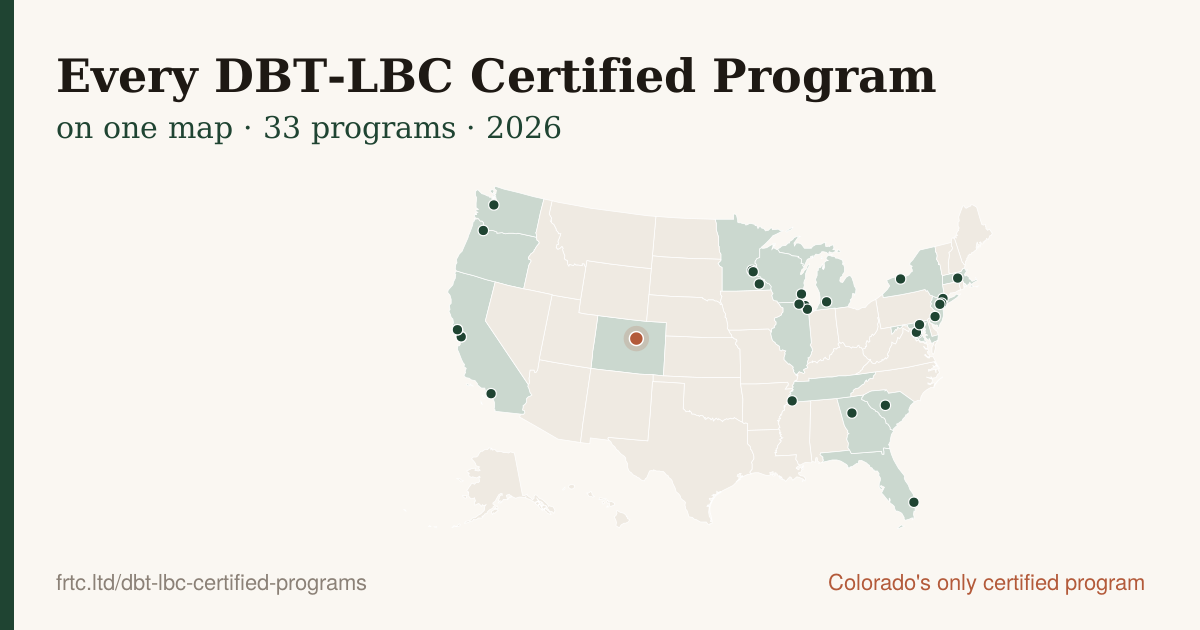 See every certified program on a map, state by state →
 How to Verify Any DBT Program
If you're evaluating DBT options anywhere — not just at FRTC — these are the four checks worth running before you commit.
Search the official directory
The DBT-Linehan Board of Certification maintains a public provider and program directory at dbt-lbc.org. Programs and individual clinicians who appear there have been independently audited. Searches by state and specialty are supported.
Ask the four-component question directly
When you contact a clinic, ask: "Do you offer all four components — individual therapy, weekly skills group, phone coaching, and therapist consultation team?" If any are missing, it isn't DBT, whatever it's called. That isn't what the research evaluates.
Ask about adherence
Beyond the four components: are sessions structured around the DBT target hierarchy? Are diary cards used? Does the therapist participate in a consultation team? These are the signals of fidelity to the Linehan model. A real DBT therapist will be able to answer these without needing to look anything up.
Confirm certification status, not just claims
Many clinicians describe themselves as "DBT-trained" or "DBT-experienced." Both are looser than certification — neither is independently verified. If certification matters to you, ask specifically and verify against the dbt-lbc.org directory.
Want the longer version? Eight questions to ask any DBT program walks through what a complete answer sounds like for each one, with a one-page checklist (PDF) to bring to a consultation.
Frequently Asked Questions
What is the DBT-Linehan Board of Certification?
How many DBT-Linehan-Board-Certified programs are there?
What is the best DBT program in Colorado?
Is FRTC DBT-Linehan-Board Certified?
What's the difference between a certified clinician and a certified program?
My therapist says they do DBT. Is that the same thing?
Why would a clinic choose not to pursue certification?
Ready for comprehensive DBT?
FRTC delivers the full Linehan model. Schedule a free phone consultation to talk through whether our adult, teen, or child DBT program is the right fit.