Comprehensive DBT vs. DBT-Informed
Comprehensive DBT and DBT-informed therapy differ in structure, intensity, and outcomes — and DBT-informed isn't a smaller dose of DBT.
In this article
If you search for “DBT therapist” in Denver, you’ll find dozens of results. Most of them offer something real — DBT skills woven into individual therapy. But there’s a meaningful difference between a therapist who uses DBT techniques and a program that delivers comprehensive DBT, and that difference affects outcomes more than most people realize when they’re looking for a provider.
This post explains what comprehensive DBT actually includes, how it differs from DBT-informed therapy, who needs comprehensive DBT (and what to do if you don’t), and how to ask the right questions when you’re evaluating options.
What Comprehensive DBT Actually Is
Comprehensive DBT — sometimes called “standard DBT” or “adherent DBT” — is a specific treatment structure developed by Marsha Linehan. It’s not a philosophy or an approach. It’s a protocol with defined components:
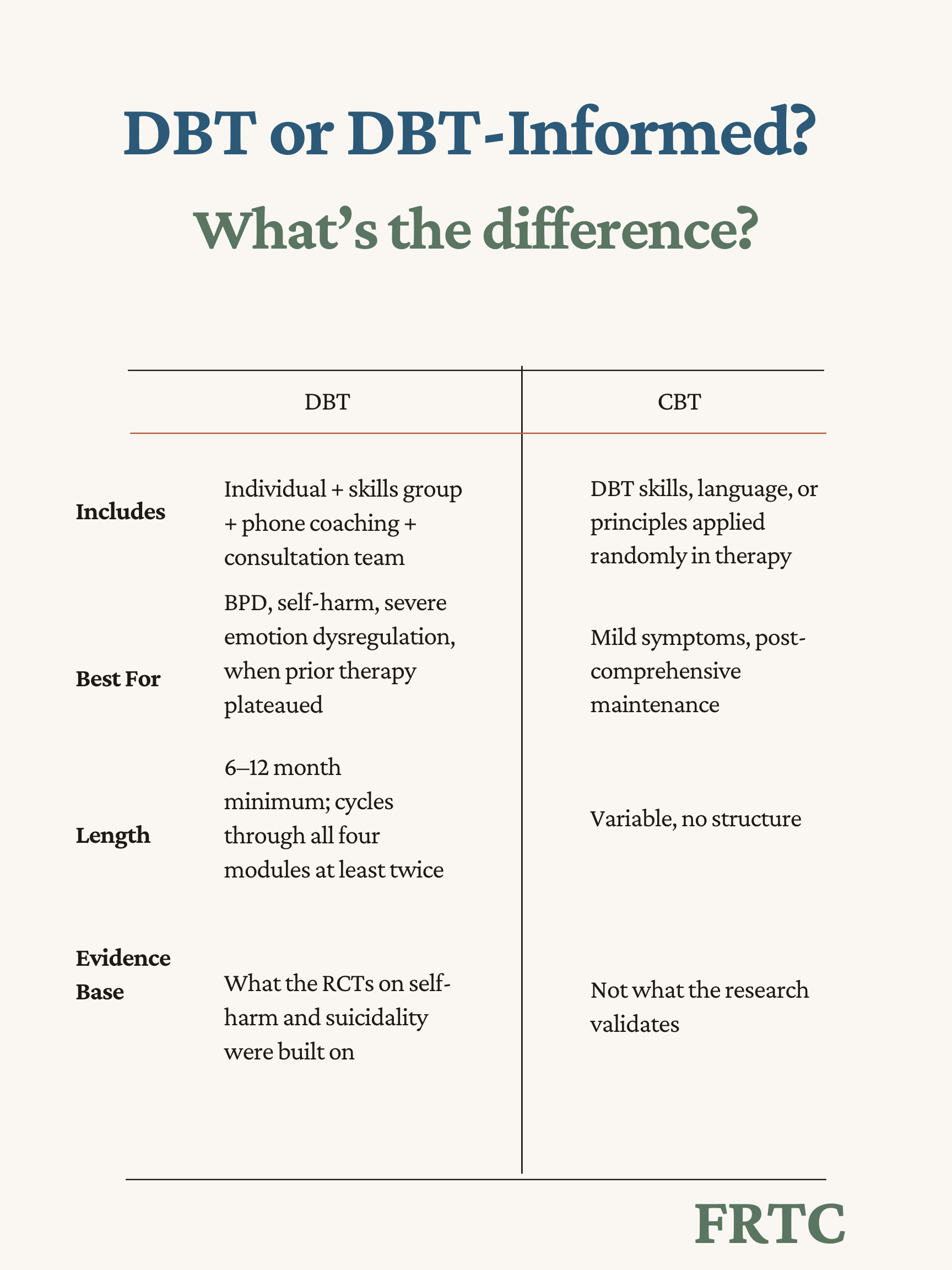
Individual therapy (weekly). One-on-one sessions with a DBT-trained therapist. These sessions follow a specific hierarchy: life-threatening behaviors first, then therapy-interfering behaviors, then quality-of-life issues, then skills acquisition. The therapist uses diary cards to track target behaviors and structures each session around the highest-priority issue.
Skills group (weekly). A structured group — usually 2 to 2.5 hours — that teaches the four DBT skill modules in rotation: mindfulness, distress tolerance, emotion regulation, and interpersonal effectiveness. Skills group is didactic and practice-based. It’s not group therapy in the traditional sense — it’s a class with homework.
Phone coaching (between sessions). Clients can contact their individual therapist between sessions for real-time help applying skills to a crisis or difficult moment. This is the component that helps skills transfer from the therapy room to actual life. It’s time-limited (usually 10-15 minutes) and focused on skill application, not processing.
Consultation team (for the therapists). The treatment team meets weekly to support each other in delivering effective, compassionate treatment. This isn’t visible to clients but directly affects treatment quality — it prevents therapist burnout and keeps the treatment on track.
Commitment to a treatment duration. Comprehensive DBT typically runs for a minimum of six months, more commonly 12 months. Clients cycle through all four skill modules at least twice. The length matters because behavioral change — especially for longstanding patterns — requires sustained practice, not a quick intervention.
Together, these constitute comprehensive DBT. Remove any one, and it’s no longer comprehensive — it’s something else.
What DBT-Informed Therapy Is
DBT-informed therapy means a therapist who has training in DBT and incorporates its skills, language, or philosophy into their individual therapy work. This might look like:
- Teaching specific DBT skills in individual sessions (distress tolerance techniques, emotion regulation strategies)
- Using DBT language and frameworks (wise mind, emotion mind, reasonable mind)
- Applying DBT principles like validation and dialectics in the therapeutic relationship
- Borrowing from DBT’s behavioral analysis approach (chain analysis, solution analysis)
- Recommending DBT workbooks or self-study between sessions
DBT-informed therapy isn’t the treatment that was tested in the research trials, and it isn’t a smaller dose of it. When comprehensive DBT isn’t indicated, the better move is usually a different evidence-based treatment delivered in full — not a partial version of DBT.
What it doesn’t include: skills group, phone coaching, consultation team, or the specific treatment hierarchy and structure that defines comprehensive DBT. And these omissions aren’t minor — they’re the components that the research on DBT’s effectiveness was built on.
Why the Distinction Matters
The evidence base for DBT — the randomized controlled trials showing reduced self-harm, reduced suicidal behavior, reduced hospitalizations, improved emotion regulation — was built on comprehensive DBT. Not on individual therapists teaching skills. Not on skills groups alone. Not on DBT-flavored individual therapy. The full package.
This matters because the components work together:
Skills group teaches the skills. Individual therapy helps you apply them to your life. Without skills group, individual therapy has to do both — teach new skills and process the week’s events — and there isn’t enough time for either.
Phone coaching bridges the gap between sessions. The hardest moments happen between appointments. Without phone coaching, the skill has to be remembered, selected, and applied without support — which, for someone in acute emotional pain, is often too much to ask.
Consultation team keeps the therapy effective. DBT clients often present with behaviors that are difficult for therapists — intense emotional reactions, crisis calls, therapy-interfering behaviors. Without consultation team support, therapist burnout is more likely, and burned-out therapists provide worse treatment.
Who Needs Comprehensive DBT
Comprehensive DBT was designed for specific populations and is most appropriate when:
Borderline personality disorder is the primary diagnosis. This is what DBT was built for. The evidence is strongest here, and comprehensive DBT is the gold-standard treatment for BPD. If you have a BPD diagnosis, comprehensive DBT should be your first consideration.
Self-harm or suicidal behavior is present. Comprehensive DBT’s treatment hierarchy places life-threatening behaviors at the top. The structure — diary cards, chain analysis, phone coaching — is specifically designed to interrupt self-harm patterns and replace them with skills.
Emotion dysregulation is severe and pervasive. If emotional reactions are consistently disproportionate to situations, if emotional pain is intense and prolonged, if emotional vulnerability affects most areas of life — the full DBT structure provides the intensity that matches the problem.
Previous therapy hasn’t worked. If you’ve done individual therapy (even good individual therapy) and the core patterns haven’t shifted, the structured approach of comprehensive DBT often succeeds where less structured treatment plateaus.
Interpersonal chaos is a pattern. Repeated relationship crises, difficulty maintaining stable relationships, alternating between idealization and devaluation — these patterns respond to the combination of interpersonal effectiveness skills (group) and in-vivo relationship work (individual therapy + phone coaching).
When Comprehensive DBT Isn’t the Right Fit
Comprehensive DBT isn’t the answer to every problem. It’s usually not what you need when:
Emotion dysregulation isn’t your primary concern. Anxiety, depression, OCD, or a stressful life transition each have their own evidence-based treatments — CBT, or exposure and response prevention for OCD — and those, delivered as designed, fit better than borrowing a few DBT skills.
Your symptoms are moderate, not severe. If you’re generally functioning well but struggling in specific areas, the full comprehensive structure may be more than you need. A structured, time-limited therapy aimed at that area is usually the right starting point.
You’ve completed comprehensive DBT and want maintenance. Graduates typically step down to less frequent individual sessions focused on applying the skills to new challenges, ideally with a clinician who knows the model.
Practical barriers get in the way. Schedule, cost, availability. Comprehensive DBT is a significant commitment (individual therapy plus a weekly skills group, typically for a year). If it isn’t feasible right now, ask a certified program what’s realistic — online DBT removes the travel barrier — rather than settling for a version that drops the components the research depends on.
Questions to Ask When Evaluating Providers
When a therapist or practice says they offer “DBT,” these questions clarify what you’re actually getting:
-
“Do you offer all four components — individual therapy, skills group, phone coaching, and consultation team?” If yes, it’s comprehensive. If they offer some but not all, ask which components they include and why.
-
“Is your skills group a full DBT skills group that cycles through all four modules?” Some practices offer “DBT skills groups” that are actually general coping skills groups with some DBT content. A true DBT skills group follows the manual and covers all modules.
-
“Do you provide between-session phone coaching?” This is often the first component to get dropped. Its absence is a significant structural gap.
-
“Is your treatment team meeting weekly for consultation?” A solo therapist doing “comprehensive DBT” without a consultation team isn’t meeting the standard. Consultation team isn’t optional in the model.
-
“What’s the expected treatment duration?” Comprehensive DBT has a minimum commitment (usually 6-12 months). If someone offers “a few sessions of DBT,” that’s DBT-informed individual therapy, not comprehensive DBT.
-
“What training have you or your team completed?” Look for intensive training from Behavioral Tech (Linehan’s training organization), or equivalent. A weekend workshop is a start, not an endpoint.
The Bottom Line
DBT-informed therapy and comprehensive DBT aren’t two sizes of the same treatment. The key is matching the treatment to the problem.
If your struggles are moderate and specific, a focused evidence-based therapy such as CBT is usually the better fit. If you’re dealing with BPD, chronic self-harm, severe emotion dysregulation, or patterns that haven’t shifted despite previous therapy — comprehensive DBT, with all its components, is what the evidence supports.
At FRTC, we offer comprehensive DBT — individual therapy, skills group, phone coaching, and consultation team. If you’re trying to figure out which level of care fits, a consultation call is the right place to start. We’ll tell you honestly whether our program is the right match or whether something else would serve you better.
Related Reading
Want to learn these skills properly?
Reading about a skill and practicing it with a trained DBT therapist are different things. Our skills classes run the full Linehan curriculum alongside individual therapy.
Send a message →We usually reply within one business day. In a crisis, call or text 988.