DEAR MAN (DBT Skill)
DEAR MAN is the DBT interpersonal effectiveness skill for making requests and saying no. Each letter, full dialogue examples, and a cheat sheet.
In this article
- On This Page
- What Is the DEAR MAN Acronym in DBT?
- Breaking Down the DEAR MAN Acronym Step by Step
- D — Describe
- E — Express
- A — Assert
- R — Reinforce
- M — Stay Mindful
- A — Appear Confident
- N — Negotiate
- When to Use DEAR MAN
- DEAR MAN Examples by Situation
- DEAR MAN example: asking a partner for help
- DEAR MAN example: setting a boundary with a parent
- DEAR MAN example: requesting a schedule change at work
- Common Mistakes
- Skipping the Assert
- Over-apologizing
- Using It as a Weapon
- Only Using It in Crisis
- DEAR MAN in Practice: A Full Example
- A Full DEAR MAN Dialogue: A Real Conversation
- How to Write Your Own DEAR MAN Script
- DEAR MAN Cheat Sheet
- DEAR MAN and Emotional Intensity
- The Three Interpersonal Goals
- Where to Learn DEAR MAN
- Frequently Asked Questions About DEAR MAN
- Related Reading
DEAR MAN is a DBT interpersonal effectiveness skill that stands for Describe, Express, Assert, Reinforce, stay Mindful, Appear confident, and Negotiate. It is the primary framework taught in dialectical behavior therapy for making effective requests and saying no while maintaining relationships and self-respect.
If there’s one DBT skill that people remember long after therapy ends, it’s DEAR MAN. It’s practical, it’s memorable, and it works — whether you’re asking your boss for a raise, setting a boundary with a family member, or telling a friend you need something to change.
DEAR MAN is the cornerstone of DBT’s interpersonal effectiveness module. It gives you a step-by-step framework for making requests and saying no in a way that’s clear, respectful, and effective. No more hoping people read your mind. No more avoiding the conversation entirely and stewing in resentment.
This guide covers every step of DEAR MAN with real-world examples, a full dialogue, a printable cheat sheet, common mistakes, and how it connects to the broader DBT interpersonal skills (GIVE and FAST).
Want to write yours now? Use the free DEAR MAN script builder — rank what matters most, fill in a few lines, and it assembles a script you can copy or print before the conversation.
On This Page
- What the DEAR MAN acronym stands for
- Each letter, step by step
- When to use DEAR MAN
- DEAR MAN examples by situation
- Common mistakes people make
- A full DEAR MAN dialogue example
- How to write a DEAR MAN script before a conversation
- DEAR MAN cheat sheet (printable)
- How DEAR MAN fits with GIVE and FAST
- Where to learn and practice DEAR MAN
- Frequently asked questions
What Is the DEAR MAN Acronym in DBT?
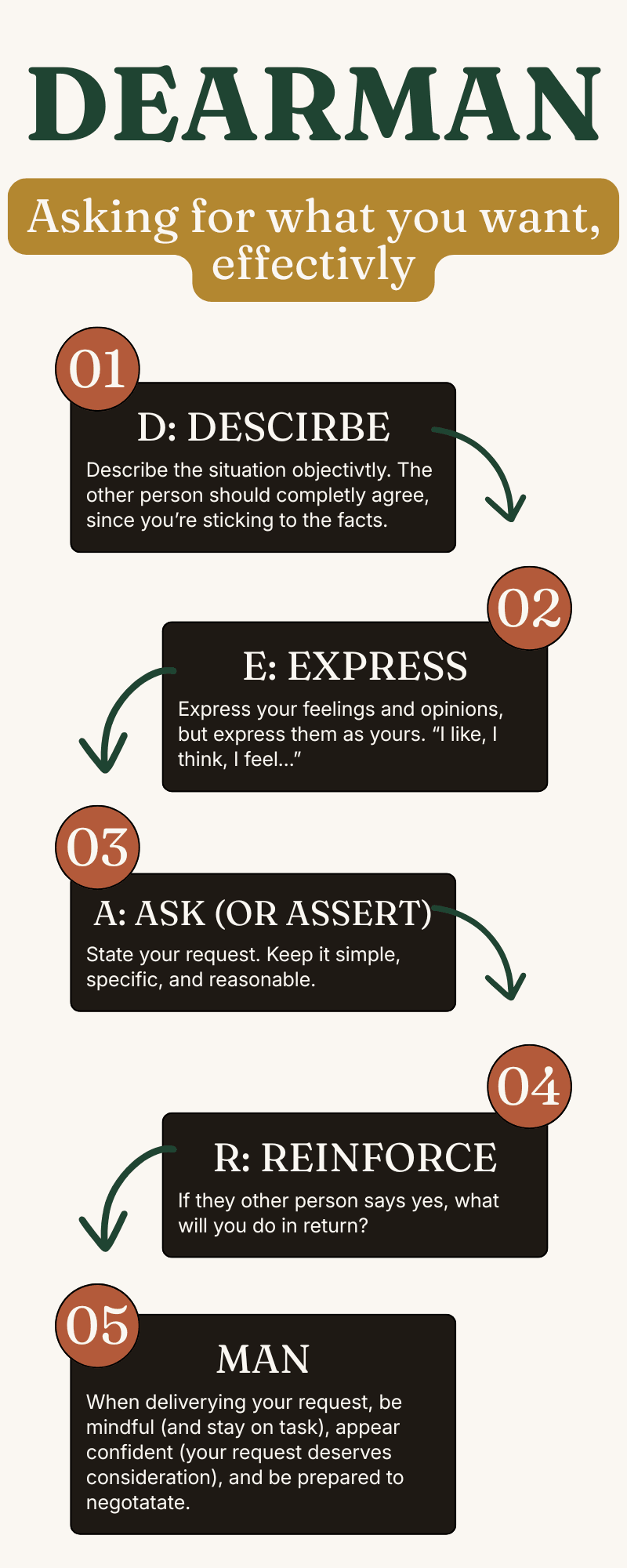
DEAR MAN is an acronym used in dialectical behavior therapy (DBT) that stands for Describe, Express, Assert, Reinforce, stay Mindful, Appear confident, and Negotiate. It is the primary skill taught in the interpersonal effectiveness module for making effective requests and saying no. Each letter represents a step in the process — the first four letters (DEAR) guide what you say, while the last three (MAN) guide how you say it.
Breaking Down the DEAR MAN Acronym Step by Step
Each letter in DEAR MAN represents a specific step. The first four (DEAR) focus on what you say. The last three (MAN) focus on how you say it.
D — Describe
Start by describing the situation factually, without judgment or interpretation. Stick to what happened — the observable facts — not your feelings about it yet.
Instead of: “You never help around the house.” Try: “The dishes have been in the sink for three days, and the trash hasn’t been taken out this week.”
Describing sets the stage. It makes sure both people are talking about the same thing before emotions enter the picture.
E — Express
Now share how you feel about the situation. Use “I” statements rather than “you” accusations.
Instead of: “You clearly don’t care about this family.” Try: “I feel overwhelmed when the chores pile up, and I start to feel like I’m carrying it alone.”
Expressing feelings invites empathy. Accusing triggers defensiveness. The difference matters.
A — Assert
Clearly state what you want or need. This is where many people stumble — they describe the problem and express their feelings but never actually make the ask.
Example: “I’d like us to split the chores more evenly. Can we sit down this weekend and make a plan?”
Be specific. Vague requests (“I just need more help”) are easy to misunderstand or dismiss. Concrete asks are harder to ignore.
R — Reinforce
Explain why saying yes benefits both of you. Reinforcement isn’t bribery — it’s helping the other person understand the positive outcome.
Example: “If we can figure this out, I think we’ll both feel less stressed, and I won’t be bringing that frustration into our evenings together.”
M — Stay Mindful
This is where execution matters. Stay focused on your goal. Don’t get pulled into side arguments, old grievances, or distractions. If the conversation veers off track, gently bring it back.
The “broken record” technique lives here: calmly repeat your request if the other person tries to derail. You don’t need to escalate. You just need to stay on point.
A — Appear Confident
Even if you feel nervous, use confident body language. Make eye contact. Speak in a steady tone. Stand or sit up straight. Don’t apologize for having a need.
This doesn’t mean being aggressive. It means presenting yourself as someone whose request deserves consideration — because it does.
N — Negotiate
Be willing to find middle ground. If the other person can’t give you exactly what you asked for, explore alternatives. You can also turn the problem over to them: “What do you think would work?”
Negotiation shows that you’re invested in the relationship, not just your own outcome. It makes the other person a collaborator rather than an opponent.
When to Use DEAR MAN
DEAR MAN is versatile. Here are some common situations where it’s especially useful:
At work: Asking for a schedule change, addressing a conflict with a coworker, requesting feedback or a promotion.
In relationships: Bringing up an issue that’s been bothering you, asking for more quality time, renegotiating responsibilities.
With family: Setting boundaries around visits or communication, expressing needs to a parent, addressing patterns that aren’t working.
With friends: Saying no to plans without guilt, asking for support, addressing something that hurt your feelings.
DEAR MAN Examples by Situation
Here are quick DEAR MAN examples across different contexts to show how the framework adapts to various situations.
DEAR MAN example: asking a partner for help
- D: “This week I made dinner every night and did the grocery shopping on Saturday.”
- E: “I’m feeling exhausted and a little resentful, and I don’t want that to build up between us.”
- A: “Could you take over dinner two nights this week?”
- R: “It would give me a break, and honestly I’d enjoy our evenings more if I’m not running on empty.”
- M: Stay on the ask if they bring up other topics.
- A: Calm, direct tone — no apologizing for the request.
- N: “If cooking feels like too much, even picking up takeout on those nights would help.”
DEAR MAN example: setting a boundary with a parent
- D: “When we talk on the phone, you sometimes comment on my weight or what I’m eating.”
- E: “It makes me feel self-conscious and less likely to want to call.”
- A: “I need you to stop commenting on my body or food choices.”
- R: “If that’s off the table, I think our calls will be a lot more enjoyable for both of us.”
- M: If they say “I’m just worried about your health,” redirect: “I appreciate the concern. What I need is for those comments to stop.”
- A: Steady voice, no wavering.
- N: “If something genuinely worries you about my health, I’d rather you ask how I’m doing overall instead of commenting on specific meals.”
DEAR MAN example: requesting a schedule change at work
- D: “I’ve been working the closing shift every Friday for the past two months.”
- E: “I’m missing family events and it’s starting to affect my morale.”
- A: “I’d like to rotate off the Friday closing shift at least twice a month.”
- R: “I think I’ll bring more energy to the shifts I do work, and it’s a fairer distribution across the team.”
- M: Don’t get sidetracked by “well, nobody likes Friday closing.”
- A: Professional, matter-of-fact delivery.
- N: “If every other week doesn’t work, I’m open to trading with someone who prefers Fridays.”
Common Mistakes
Skipping the Assert
The most common DEAR MAN error is doing the D and E but never getting to A. You describe the problem, express your feelings, and then… wait for the other person to figure out what you need. They usually don’t.
Over-apologizing
Starting with “I’m sorry to bring this up, I know it’s probably annoying, but…” undermines the entire framework. You have a right to make requests. The FAST skill (part of the same DBT module) specifically addresses this pattern.
Using It as a Weapon
DEAR MAN is designed for respectful, assertive communication — not manipulation. If you’re using the framework to steamroll someone into compliance, you’ve missed the point. The negotiation step exists for a reason.
Only Using It in Crisis
DEAR MAN works best when you use it early, before resentment builds. The conversation about the dishes is much easier on day three than on day thirty.
DEAR MAN in Practice: A Full Example
Imagine you’ve been covering for a coworker who consistently leaves early, and it’s affecting your workload.
Describe: “Over the past few weeks, I’ve noticed I’ve been covering the closing tasks when you leave before your shift ends.”
Express: “I’m starting to feel burned out, and it’s hard to manage my own responsibilities plus the extra work.”
Assert: “I’d like us to figure out a way to make sure closing duties are shared more evenly.”
Reinforce: “That way neither of us is carrying more than our share, and the shift runs smoother for everyone.”
Mindful: If they bring up something unrelated (“Well, you took a long lunch on Tuesday”), gently redirect: “I hear you, and we can talk about that too. Right now I’d like to focus on the closing duties.”
Appear confident: Steady tone, eye contact, no fidgeting or trailing off.
Negotiate: “Would it help if we alternated closing days? Or is there another arrangement that would work for you?”
A Full DEAR MAN Dialogue: A Real Conversation
The bullet-point examples above give you a feel for each step. But DEAR MAN in real life isn’t a monologue — it’s a conversation. Here’s what it sounds like when someone uses the full skill in a tough moment with a partner.
Setting: Jamie has been working late most nights. Their partner Alex has been handling pickup, dinner, and bedtime for their daughter solo for three weeks. Alex is exhausted and resentful. They sit down after the kid is asleep.
Alex: “Hey — can we talk for a few minutes? Nothing’s on fire, I just want to get something on the table before it gets worse.”
Jamie: “Sure, what’s up?”
(Describe) Alex: “So over the last three weeks, I’ve done pickup every day, made dinner every night except Sunday, and handled bedtime every night. You’ve been home around 8:30 or 9.”
(Express) Alex: “I’ve been feeling burned out, and honestly a little invisible. I know your project is intense, and I’m not mad — but I’m running out of gas.”
(Assert) Alex: “I’d like us to come up with a plan where I’m not solo-parenting every night. Even two nights of you doing pickup and bedtime would change everything.”
(Reinforce) Alex: “If we can figure this out, I’ll actually be glad to see you when you get home instead of secretly counting how many nights it’s been. And our kid’s been asking when you can do bath time.”
Jamie: “I’ve been killing myself on this launch. It’s hard to leave at 5.”
(Mindful — staying on goal) Alex: “I hear that, and I know the launch is real. I’m not asking for every night — I’m asking for a couple. Could we pick two evenings a week where you commit to being home by 5:30?”
Jamie: “Tuesdays and Thursdays are lighter for me usually.”
(Negotiate) Alex: “Okay — let’s try Tuesday and Thursday. If one of those doesn’t work a given week, can you give me a heads-up by lunchtime so I can plan? And if the launch wraps in two weeks, can we revisit and add a third?”
Jamie: “Yeah, that’s fair.”
Notice a few things. Alex never says “you never help” or “you don’t care.” There’s no character assassination, no score-keeping, no “always” or “never.” The describe is specific and recent — three weeks, not “forever.” The ask is concrete (two specific nights), not vague (“help more”). When Jamie pushes back, Alex doesn’t escalate or collapse; they restate the ask in a smaller form and leave room for Jamie to contribute. When Jamie offers something, Alex accepts it and adds guardrails (the heads-up, the revisit). The whole exchange is maybe three minutes. That’s DEAR MAN when it works.
How to Write Your Own DEAR MAN Script
For a conversation you expect to be emotionally loaded, it helps to draft your DEAR MAN before you’re in the room. Not word-for-word — that sounds stilted and robotic — but enough to know what each letter looks like for your specific situation.
A working template:
- Describe: “In the last [time window], I noticed [specific, observable facts].”
- Express: “I’ve been feeling [emotion], and [brief impact on me].”
- Assert: “I’d like us to [specific, concrete ask].”
- Reinforce: “If we can do this, [positive outcome for both of us].”
- Mindful: [If they bring up X, you’ll say: “I hear you, and we can come back to that. Right now I’d like to finish this.”]
- Appear confident: [Body language cues: feet planted, steady tone, no apologizing first.]
- Negotiate: [A middle-ground option: “If [full ask] isn’t workable, would [smaller version] be possible?”]
Writing the last three down (the M, A, N) is especially useful — those are the steps people skip when emotion is high. If you’ve already thought through what you’ll do if they try to derail, you don’t have to figure it out in real time.
Save the script somewhere private — your phone notes, a notebook. Review it ten minutes before the conversation. Then close it and have the conversation like a human, not a script reader.
DEAR MAN Cheat Sheet
Quick reference for when you need it:
- D — Describe: Facts only. What specifically happened, in what time window. No interpretation, no labels.
- E — Express: Your feeling about the situation. “I feel [emotion]” — not “you made me feel.”
- A — Assert: The specific ask. One concrete, doable thing.
- R — Reinforce: Why saying yes is good for them too. What changes for the better.
- M — (stay) Mindful: Stay on goal. Broken-record the ask. Don’t take bait on side issues.
- A — Appear confident: Body language, tone, eye contact. Act like your ask is reasonable — because it is.
- N — Negotiate: Offer a middle ground. Turn the problem back to them: “What do you think would work?”
DEAR MAN and Emotional Intensity
DEAR MAN is straightforward when emotions are low. The challenge is using it when you are activated — when you are angry, anxious, or hurt. This is where many people struggle, and it is where the skill matters most.
When emotional intensity is high, the steps you are most likely to skip are Describe and Negotiate. Instead of starting with facts, you lead with emotion. Instead of exploring middle ground, you either capitulate or escalate. The framework exists precisely for these moments — it gives you a script when your brain is too flooded to improvise.
A practical strategy is to write out your DEAR MAN before the conversation. Not as a speech to read verbatim, but as a way to organize your thoughts while you are still calm. What are the facts? What do you feel? What specifically do you want? What is the positive outcome for both of you? Having this clarity before the emotional pressure starts makes it significantly more likely that you will stay on track.
For people who struggle with emotion dysregulation, pairing DEAR MAN with other DBT skills can be essential. Using TIPP to bring your emotional arousal down before initiating the conversation, or practicing mindfulness to stay grounded during it, can mean the difference between a productive exchange and one that falls apart.
The Three Interpersonal Goals
It is worth understanding where DEAR MAN fits in the larger DBT framework. DBT teaches that every interpersonal situation involves three potential goals: getting what you want (objective effectiveness), maintaining the relationship (relationship effectiveness), and keeping your self-respect (self-respect effectiveness). DEAR MAN addresses the first goal. The GIVE skill addresses the second — being gentle, acting interested, validating, and using an easy manner. The FAST skill addresses the third — being fair, not over-apologizing, sticking to values, and being truthful.
In any given interaction, you have to decide which goal matters most, because sometimes they compete. Pushing hard for what you want may strain the relationship. Preserving the relationship at all costs may erode your self-respect. DEAR MAN gives you the best shot at getting your objective, but a skilled DBT practitioner learns to balance all three goals depending on the situation.
Where to Learn DEAR MAN
DEAR MAN is taught as part of the interpersonal effectiveness module in DBT skills training. At Front Range Treatment Center, our skills groups walk through each step with practice exercises, role-plays, and real-world application between sessions.
The skill sounds simple on paper — and the basics are intuitive. But using it consistently, especially under emotional pressure, takes practice. That’s what the group setting provides: repetition, feedback, and the chance to build the skill until it becomes second nature.
If you’re interested in learning DEAR MAN and the full set of DBT interpersonal skills, reach out to our team. These are some of the most immediately useful tools DBT offers.
Frequently Asked Questions About DEAR MAN
What does DEAR MAN stand for in DBT? DEAR MAN stands for Describe, Express, Assert, Reinforce, stay Mindful, Appear confident, and Negotiate. It is a DBT interpersonal effectiveness skill used for making requests and saying no assertively while maintaining relationships.
When should I use the DEAR MAN skill? Use DEAR MAN any time you need to ask for something, say no, or express a need in a way that is clear and respectful. Common situations include workplace conflicts, setting boundaries with family, negotiating in relationships, and addressing issues with friends.
What is the difference between DEAR MAN, GIVE, and FAST? DEAR MAN focuses on getting what you want (objective effectiveness). GIVE focuses on maintaining the relationship (relationship effectiveness). FAST focuses on keeping your self-respect (self-respect effectiveness). All three are taught in the interpersonal effectiveness module of DBT.
Can I use DEAR MAN outside of therapy? Absolutely. DEAR MAN is one of the most widely applicable DBT skills. You do not need to be in therapy to use it — anyone can benefit from a structured approach to assertive communication in everyday situations.
Is there a DEAR MAN worksheet I can use? The original DEAR MAN worksheet comes from Marsha Linehan’s DBT Skills Training Handouts and Worksheets. It walks through each step with blank lines for you to plan your own conversation. If you’re working with a DBT therapist, they’ll typically introduce the worksheet in skills group and have you practice it between sessions. You can also use the template in the “How to Write Your Own DEAR MAN Script” section above to draft your own.
Who invented DEAR MAN? DEAR MAN was developed by Dr. Marsha Linehan as part of the interpersonal effectiveness module of Dialectical Behavior Therapy. Linehan originally developed DBT in the 1980s as a treatment for chronically suicidal individuals and people with borderline personality disorder; the skill has since been adopted widely across anxiety, depression, eating disorder, and couples work. For primary-source background on DBT, see the Linehan Institute.
Does DEAR MAN work in text messages or email? Yes, with caveats. The Describe, Express, Assert, and Reinforce steps translate well to writing — in fact, writing can be easier because you can edit before sending. The Mindful and Appear confident steps are harder because you can’t see the other person’s reaction in real time. For high-stakes conversations (a raise, a breakup, a big family issue), in-person or video is usually better. For medium-stakes requests, a thoughtful written DEAR MAN can work beautifully.
What if DEAR MAN doesn’t work? DEAR MAN is not a magic trick — it increases your odds of being heard and getting a reasonable response, but it doesn’t guarantee it. Sometimes the other person isn’t willing or isn’t capable of meeting the request. If you’ve used the skill well and still didn’t get what you needed, that’s data: it tells you something about the relationship, and it’s worth bringing to therapy to work out the next step. Using the skill well is the goal — the outcome is partly out of your hands.
Want to learn DEAR MAN and the rest of DBT in a live class? DBT Academy runs live, online DBT skills courses taught over Zoom by trained DBT professionals — a structured way to build interpersonal effectiveness and the full skill set alongside a group. See the class options →
Related Reading
Want to learn these skills properly?
Reading about a skill and practicing it with a trained DBT therapist are different things. Our skills classes run the full Linehan curriculum alongside individual therapy.
Send a message →We usually reply within one business day. In a crisis, call or text 988.