Radical Acceptance in DBT
Radical acceptance is the most misunderstood DBT skill. Learn what it actually means, how to practice it, and why it's not the same as giving up.
In this article
- The Problem Radical Acceptance Solves
- What Radical Acceptance Actually Means
- What Radical Acceptance Is NOT
- How to Practice Radical Acceptance
- Observe That You’re Not Accepting
- Turn the Mind
- Half-Smile and Willing Hands
- Use Self-Talk
- When Radical Acceptance Is Hardest
- Radical Acceptance in Daily Life
- Radical Acceptance and Other DBT Skills
- Learning Radical Acceptance at FRTC
- Related Reading
Of all the skills in Dialectical Behavior Therapy, radical acceptance is probably the most misunderstood. People hear the phrase and assume it means giving up, tolerating abuse, or pretending everything is fine. It means none of those things.
Radical acceptance is the decision to stop fighting reality. Not to approve of it. Not to like it. Just to acknowledge what is — fully, without denial or distortion — so you can figure out what to do next.
It sounds simple. It’s one of the hardest things a human being can practice.
The Problem Radical Acceptance Solves
There’s a formula in DBT that captures this:
Pain + Non-acceptance = Suffering
Pain is unavoidable. People get sick. Relationships end. Loved ones die. Trauma happens. You can’t always control what life throws at you. That’s pain.
Suffering is what happens when you add non-acceptance to pain. Non-acceptance sounds like: “This shouldn’t have happened.” “It’s not fair.” “I can’t stand this.” “Why me?” These thoughts are understandable — but they don’t change what happened. They only add a second layer of anguish on top of the original pain.
Radical acceptance targets that second layer. By fully accepting the reality of a painful situation, you don’t eliminate the pain — but you stop compounding it with suffering. You free up the mental energy that was going toward denial, bargaining, and rage, and redirect it toward coping, problem-solving, or grieving.
What Radical Acceptance Actually Means
Let’s be specific about what’s being accepted:
You accept the facts of the present moment. Not your interpretation, not your prediction about the future, just what is true right now. “I lost my job.” “My partner left.” “I have this diagnosis.” “This happened to me.”
You accept that there is a cause for everything. Every event, every behavior — including your own — is the result of a chain of causes. This doesn’t mean excusing harmful behavior. It means recognizing that the universe operates on cause and effect, and that this moment exists because of everything that came before it. Wishing it were different doesn’t change the chain.
You accept that life can be worth living even with painful events in it. This is the hardest part for many people. Radical acceptance asks you to hold two things at once: “This is terrible” and “I can still move forward.” That’s the dialectic at the heart of DBT — two seemingly opposite truths existing simultaneously.
What Radical Acceptance Is NOT
It’s not approval. Accepting that something happened doesn’t mean you think it’s acceptable. You can accept that someone abused you without condoning the abuse. You can accept a cancer diagnosis without being glad about it.
It’s not passivity. Radical acceptance doesn’t mean lying down and taking it. In fact, it’s often the prerequisite for effective action. You can’t change a situation you’re refusing to acknowledge. Acceptance comes first, then problem-solving.
It’s not a one-time event. You don’t “achieve” radical acceptance and move on. It’s a practice. You might accept something Monday morning, reject it by Tuesday night, and have to accept it again on Wednesday. Marsha Linehan describes it as “turning the mind” — a deliberate, repeated choice to orient toward acceptance rather than resistance.
It’s not forgiveness. Forgiveness is a separate process. Radical acceptance is about your relationship with reality, not your relationship with the person who hurt you. Some people practice radical acceptance of what happened to them without ever forgiving the person responsible, and that’s entirely valid.
How to Practice Radical Acceptance
Radical acceptance is a skill, which means it can be learned and strengthened through practice. Here are the core components:
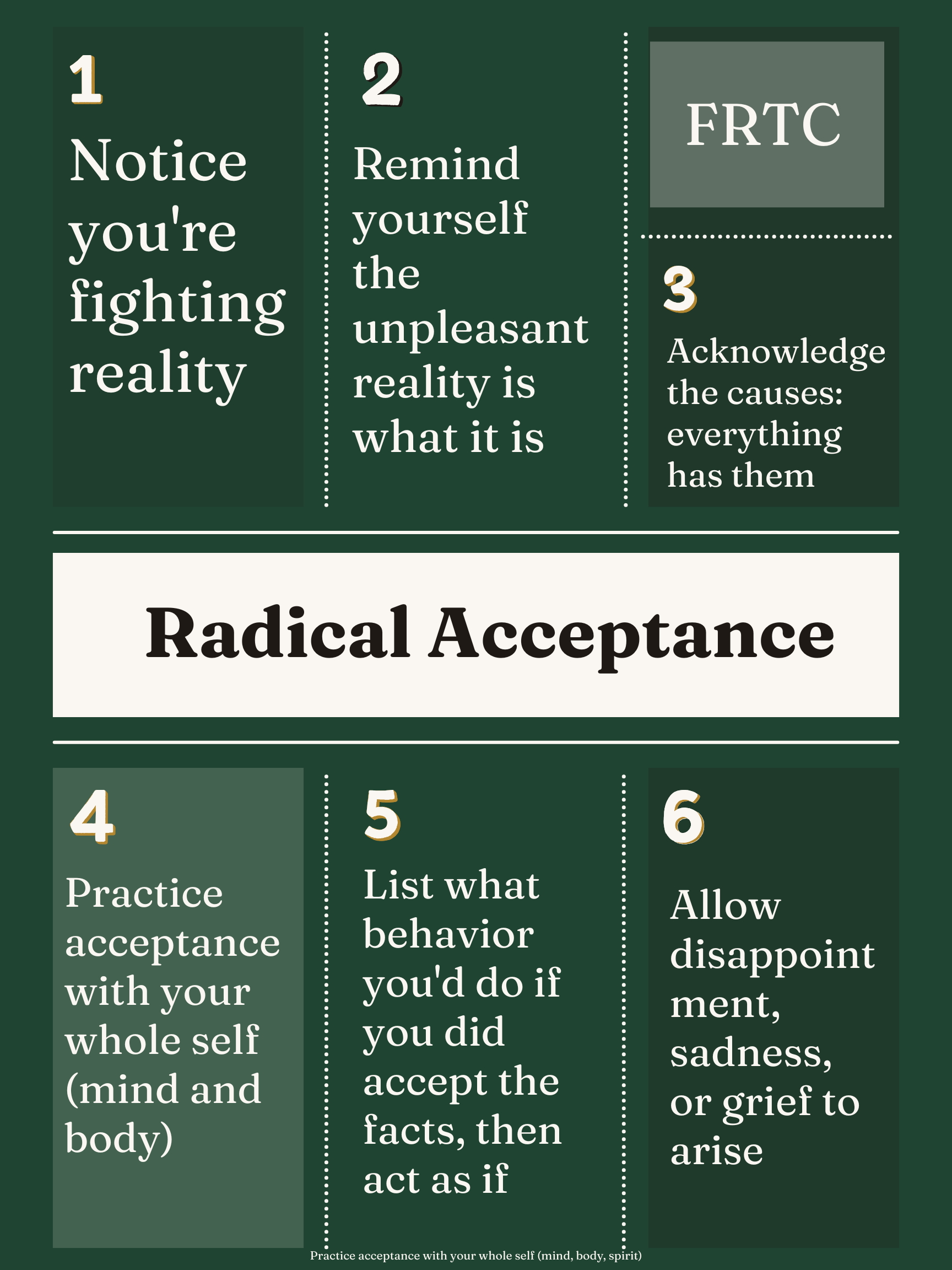
Observe That You’re Not Accepting
The first step is noticing when you’re in non-acceptance. Common signs include replaying “should have” scenarios, feeling bitter or resentful about unchangeable facts, tensing your body against emotional pain, or spending mental energy on “if only” fantasies. Mindfulness is what allows you to notice these patterns without getting swept up in them.
Turn the Mind
This is the moment of choice. You notice you’re fighting reality, and you deliberately choose to turn toward acceptance. It’s not a feeling — it’s a decision. “I am going to accept this.” You may need to make this decision dozens of times in a single day. That’s normal, not failure.
Half-Smile and Willing Hands
These are body-based techniques that support the mental shift. A half-smile — a slight, relaxed upturn of the lips — sends a signal to your nervous system that you’re not in danger. Willing hands — palms open, fingers relaxed — is the physical posture of openness rather than resistance. These feel strange at first, but the mind-body connection is real.
Use Self-Talk
Phrases that support radical acceptance: “This is what happened.” “I can’t change the past.” “Fighting this is only making it worse.” “I can accept this and still be in pain.” “This moment is the result of a million previous moments.” Find the words that work for you and repeat them when non-acceptance takes over. Writing them down and keeping them accessible — on your phone, on a card in your wallet — means they’re available when you need them most.
When Radical Acceptance Is Hardest
Radical acceptance tends to be most difficult around events that feel deeply unfair — childhood trauma, sudden loss, chronic illness, betrayal by someone you trusted. The more senseless the pain, the harder it is to stop fighting it.
It’s also hard when other people don’t validate your pain. If the world around you is saying “get over it” or “it wasn’t that bad,” radical acceptance can feel like joining their team against yourself. It’s not. Radical acceptance validates the pain completely — “this is real, this hurts, and I don’t have to pretend otherwise” — while releasing the war against the unchangeable facts.
For people dealing with trauma, radical acceptance often works best when paired with professional support. DBT for trauma combines acceptance skills with trauma processing to help people move through experiences that feel impossible to accept.
It’s also hard when the loss or injustice is ongoing. Chronic illness, a difficult relationship you can’t leave, a job you need but hate — these require a different kind of radical acceptance, one that doesn’t have the finality of accepting a past event. In these cases, radical acceptance becomes a daily practice of acknowledging what you can and cannot control, and redirecting your energy toward the parts of the situation where change is possible. This is where acceptance and change exist in genuine dialectical tension — and learning to hold both is the core of DBT.
Radical Acceptance in Daily Life
Radical acceptance isn’t just for major life events. You can practice it with everyday frustrations:
Traffic. The meeting that ran long. The friend who canceled. The weather. The thing you said that you can’t take back. Each of these is an opportunity to practice: “This is what’s happening. Fighting it doesn’t change it. What can I do right now?”
The more you practice with small things, the more accessible the skill becomes when you need it for big ones. This is how DBT skills transform daily life — not through dramatic breakthroughs, but through consistent, quiet practice.
Radical Acceptance and Other DBT Skills
Radical acceptance doesn’t work in isolation — it’s one tool in a larger toolkit. When the pain of the accepted reality is overwhelming, TIPP skills can help manage the physiological intensity so that acceptance remains possible. When acceptance reveals a problem that can be solved, interpersonal effectiveness and emotion regulation skills provide the tools for action.
The relationship between radical acceptance and opposite action is particularly important. Once you’ve accepted reality, you can evaluate whether your current emotions fit the facts. If they do, you feel the feelings fully. If they don’t — if you’re still raging against something you’ve accepted can’t be changed — opposite action helps you shift the emotional response. Acceptance is what makes that evaluation possible. Without it, you’re stuck in the fight.
Learning Radical Acceptance at FRTC
At Front Range Treatment Center, radical acceptance is taught in the distress tolerance module of our DBT skills classes. You’ll practice it alongside other distress tolerance skills like TIPP, pros and cons, and self-soothing — a full toolkit for navigating pain without making it worse.
If you’re interested in learning DBT skills, contact us to learn about our comprehensive DBT programs for adults and teens.
Related Reading
Want to learn these skills properly?
Reading about a skill and practicing it with a trained DBT therapist are different things. Our skills classes run the full Linehan curriculum alongside individual therapy.
Send a message →We usually reply within one business day. In a crisis, call or text 988.