TIPP Skills in DBT: The 4 Distress Tolerance Steps
TIPP is four DBT distress tolerance skills — Temperature, Intense exercise, Paced breathing, Paired muscle relaxation — that calm intense emotion fast.
In this article
What Are the TIPP Skills in DBT?
TIPP is a DBT distress tolerance skill that stands for Temperature, Intense exercise, Paced breathing, and Paired muscle relaxation. It is a set of four physiological interventions designed to rapidly reduce the intensity of extreme emotions during a crisis. Unlike cognitive skills that work through changing your thoughts, the TIPP skill works through your body — changing your body chemistry to bring emotional arousal down quickly.
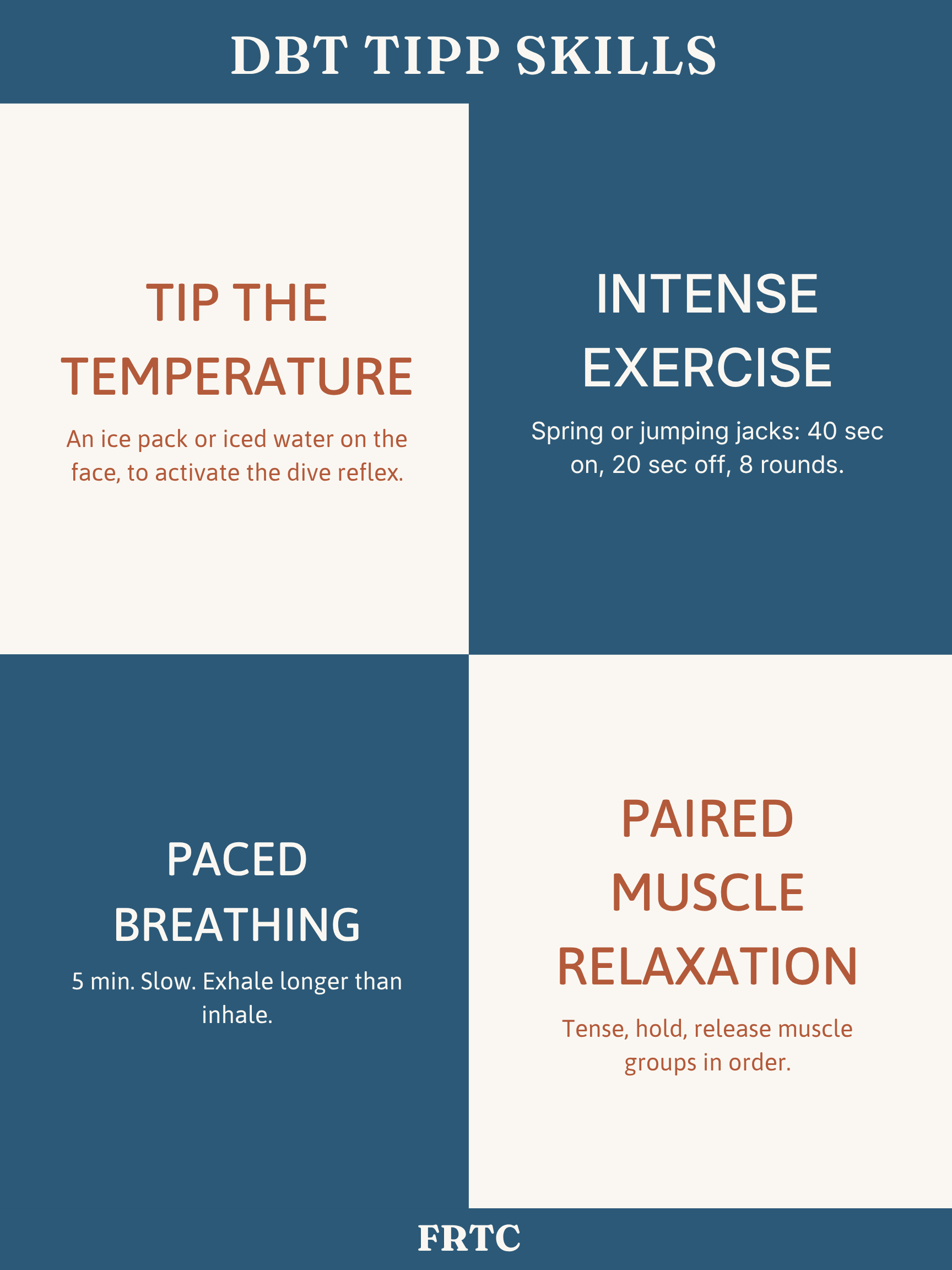
In dialectical behavior therapy (DBT), the distress tolerance skills are those used during periods of intense emotions, difficult experiences or crisis situations, when your primary goal is to “make it through” without making the situation worse. These DBT crisis survival skills are effective when you are experiencing an intense emotion that feels like it will last forever, when you feel too overwhelmed by an emotion to complete a current task, or when you are worried you might resort to some really ineffective or risky coping behavior. The first crisis survival skill you learn in DBT will probably be the TIPP skill.
The TIPP skills can be used to prepare you for an event that may potentially cause you distress or anxiety, and also to lower your emotional intensity after a distressing event.
If we are experiencing an emotion at an intensity of 10 out of 10, we do not have the capacity to use interpersonal effectiveness or emotion regulation skills, we first need to lower the emotional intensity by using distress tolerance skills, like the TIPP skill. The goal is to use the TIPP skill to decrease emotional intensity in a situation, so we can then effectively use other emotional regulation or interpersonal effectiveness skills, and generally proceed effectively, without making a situation worse.
The TIPP skill is actually four interventions. Each letter in TIPP provides a different method of reducing emotion quickly.
The Four TIPP Skills Step by Step
T: Tip the Temperature
Also called ice diving, this skill exploits the human “dive response.” There are nerve endings on parts of the face that, when suddenly exposed to cold water, send a powerful signal to the brain and ramp up the parasympathetic nervous system. It is thought this response helps to keep us alive longer, should we fall into cold water. But, we can create this response ourselves by applying cold to the right places.
The result? Your heart rate and breathing slow down as blood flow is directed away from your limbs and towards your heart and brain, calming the body, and then (hopefully) the mind.
To perform this skill, try putting your face in a bowl of cold water while holding your breath, making sure to submerge the area near your temples. You can also try holding an ice pack up to this part of your face, though this doesn’t work quite as well. Whichever method you choose, hold for 30 seconds.
In our experience, this skill works really well for about ⅓ of people, ok for about ⅓, and ⅓ of people don’t like it. Try it a few times, and try to figure out which group you fall into.
I: Intense Exercise
Do some type of intense exercise to calm your body when experiencing intense emotion. The duration of the exercise can be short or long, but it must be intense! This helps to burn off excess energy, and can wear you out so much that you don’t have the energy to be emotional. More importantly, it provides an alternative reason for the physiological arousal that comes with emotion. When emotions are high, your body goes into overdrive. Then, engage in some intense exercise. Now, your heart rate is high because you’re running, not because you’re upset! When your heart rate returns to baseline after the exercise is over, you may find your emotions subside, at least partially, with it.
One of our favorite forms of intense exercise is a sprint tabata. Find an open field, a smooth road, or a treadmill. Run as fast as you can for 20 seconds, and rest for 10 seconds. (There are lots of apps and videos to help with the timing). Repeat 8 times. In just four minutes, your emotional outlook might be very different.
P: Paced Breathing
Breathe deeply to slow your breathing pace from your natural pace to about 5-6 breaths per minute. Exhale for longer than you inhale. You may find it helpful to count 5 seconds per inhale and 7 seconds per exhale. Breathe like this for about two minutes. Using paced breathing can help reduce the emotion’s physiological effects, like increased heart rate and sweating.
The best thing about paced breathing is it helps almost everyone, and you can do it anywhere. Driving? In a meeting? Giving a speech? You can use paced breathing, and no one will know. The downside? Paced breathing is hard, and you have to practice for a while before you get good at it. Try just 5 minutes a day for 2 weeks, and you’ll probably be skilled enough to use it anytime, anywhere.
There are many free paced breathing apps available; search your app store for “paced breathing” and pick one with an adjustable exhale.
P: Paired Muscle Relaxation
Pairing paced breathing with muscle relaxation calms your body by releasing built-up tension you may not even realize is there. You may find it helpful to start at the top of your head and move down your body, tensing one part of your body at a time. First, breathe in deeply through your nose while tensing your facial muscles for 5 seconds and say in your mind, “I breathe in to be calm”. Then, noticing the tension in this part of your body, breathe out through your mouth while saying, “I breathe out to stay calm” in your mind. Release the tension, and notice how this feels in your body. Repeat these steps for your neck and shoulders, arms and hands, abdominals, thighs, calves, then feet. Like intense exercise, paired muscle relaxation is a way to release built-up energy and tension in your body.
It can be hard to get this skill down at first, so it is important to practice with prompts. Check out our muscle relaxation video here.
When to Use TIPP vs. Other Skills
TIPP is specifically designed for high-intensity moments — when your emotional arousal is at a 7 or above on a 10-point scale. It is not meant for everyday emotional management. For moderate emotions, skills like opposite action, check the facts, or mindfulness are usually more appropriate and address the underlying emotional pattern rather than just the intensity.
Think of TIPP as the emergency brake. It stops the car quickly, but it is not how you steer. Once TIPP has brought your emotional intensity down to a manageable level, you can then use emotion regulation and interpersonal effectiveness skills to address whatever triggered the crisis in the first place. The sequence matters: trying to use complex cognitive skills when your arousal is through the roof usually does not work, because the prefrontal cortex — the part of your brain responsible for rational thinking — goes offline during extreme emotional states. TIPP brings it back online.
Practicing TIPP Before You Need It
One of the most important things about TIPP is that you need to practice it before a crisis hits. If the first time you try paced breathing is when you are having a panic attack, it will not go well. If you have never held ice or splashed cold water on your face, you will not think to do it when you are in the middle of an emotional meltdown.
Build TIPP into your daily routine as a practice skill, not just a crisis skill. Try paced breathing for five minutes each morning. Practice paired muscle relaxation before bed. Try the temperature skill after a stressful workday, even if you are not in crisis, just to get comfortable with the sensation. The more familiar the skills become during calm moments, the more automatically they will kick in during difficult ones.
Many of our clients at Front Range Treatment Center report that once they have practiced TIPP regularly, they begin using the skills almost reflexively — reaching for ice when they notice their anger rising, shifting into paced breathing during a tense meeting, or doing a quick sprint tabata after a difficult phone call. The skill moves from something you have to consciously remember to something your body reaches for naturally.
TIPP for Specific Situations
While TIPP works across a wide range of emotional crises, some components are better suited to certain situations than others.
For panic attacks, paced breathing and temperature are typically the most effective because they directly counteract the sympathetic nervous system activation that drives the physical symptoms of panic. The dive response in particular can interrupt a panic attack rapidly by activating the parasympathetic nervous system.
For intense anger, intense exercise is often the best first step because anger generates significant physical energy that needs somewhere to go. Trying to breathe through intense anger when your body is flooded with adrenaline can feel impossible. A short burst of physical activity burns off that energy and creates the physiological conditions for calmer thinking.
For overwhelming sadness or emotional pain — the kind that makes you feel like you cannot survive another minute — paired muscle relaxation combined with paced breathing provides a soothing, grounding experience that can help you ride the wave until the intensity passes. Combined with radical acceptance — acknowledging the pain without fighting it — this approach can get you through moments that feel unbearable.
For urges to self-harm, the temperature skill works on the physiology driving the urge rather than standing in for the behavior: cold water on the face activates the dive response, which lowers heart rate and reduces the arousal that makes an urge feel unanswerable. This is a bridge skill — it does not address the underlying pain, but it can buy enough time to reach other resources, including your therapist through phone coaching.
Frequently Asked Questions About TIPP
What does TIPP stand for in DBT? TIPP stands for Temperature, Intense exercise, Paced breathing, and Paired muscle relaxation. These are four body-based skills in DBT’s distress tolerance module that quickly reduce the intensity of extreme emotions.
How quickly does the TIPP skill work? TIPP skills can begin reducing emotional intensity within 30 seconds to a few minutes. Tipping the temperature (the dive response) works the fastest, often within 30 seconds. Intense exercise typically takes a few minutes. Paced breathing and paired muscle relaxation work within two to five minutes.
Is TIPP the same as TIP? Some DBT programs teach TIP (three skills) instead of TIPP (four skills). The difference is that TIP combines the last two skills — paced breathing and paired muscle relaxation — into one category, while TIPP teaches them as separate techniques. The core skills are the same.
Want to learn DBT skills in a live class? DBT Academy offers live, online DBT skills courses taught over Zoom by trained DBT professionals — a structured way to learn TIPP and the full distress-tolerance toolkit alongside a group. See the class options →
Related Reading
Want to learn these skills properly?
Reading about a skill and practicing it with a trained DBT therapist are different things. Our skills classes run the full Linehan curriculum alongside individual therapy.
Send a message →We usually reply within one business day. In a crisis, call or text 988.