How to Find the Best DBT Therapist
The best DBT therapist delivers comprehensive DBT — not just a few DBT skills. Credentials, program structure, and red flags.
In this article
- What Makes a DBT Therapist the “Best”?
- Real DBT vs. a Few DBT Skills: The Critical Distinction
- How to Evaluate a DBT Therapist: Questions to Ask
- About program structure
- About training and credentials
- About treatment approach
- Red Flags When Searching for a DBT Therapist
- Where to Search for Qualified DBT Therapists
- Why Certification Matters
- What About Cost and Insurance?
- Frequently Asked Questions
- How do I know if my therapist is actually doing DBT?
- Is it worth waiting for a certified program?
- Can I do DBT online?
- What if there’s no comprehensive DBT program near me?
- How long does DBT treatment take?
What Makes a DBT Therapist the “Best”?
The best DBT therapist is one who delivers comprehensive Dialectical Behavior Therapy — meaning they provide the full treatment model as designed by Dr. Marsha Linehan, not a watered-down version that borrows a few DBT concepts. This distinction matters more than credentials, personality, or how many years someone has been in practice. A therapist who does genuine comprehensive DBT will almost always produce better outcomes for clients with emotion dysregulation, borderline personality disorder, chronic suicidality, or self-harm than one who uses a few DBT skills.
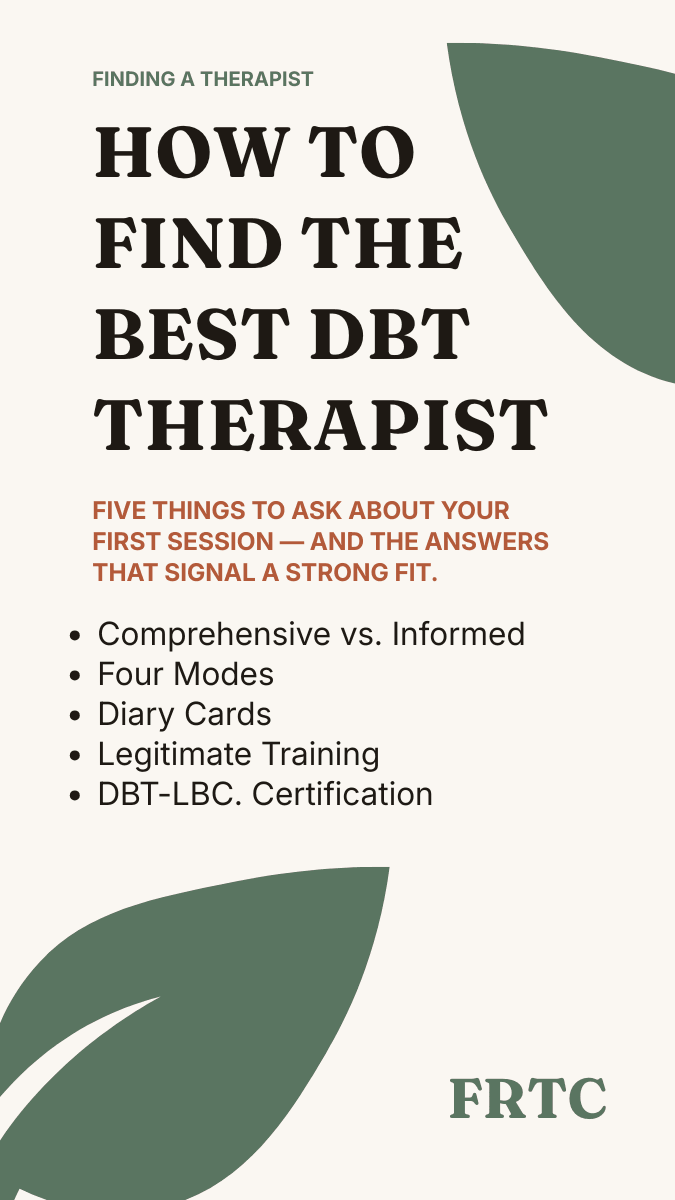
Finding the right DBT therapist can feel overwhelming — especially because so many therapists list DBT as a specialty without actually delivering the full model. This guide will help you tell the difference and find someone who can genuinely help.
Real DBT vs. a Few DBT Skills: The Critical Distinction
The single most important factor when choosing a DBT therapist is whether they offer comprehensive DBT or just a few DBT skills. These are not the same thing, and the difference directly impacts your outcomes.
Comprehensive DBT includes all four components:
- Weekly individual therapy — Your therapist reviews your diary card, addresses target behaviors in priority order, and helps you apply skills to real-life situations.
- Weekly skills group — A structured class (not group therapy) where you learn the four DBT skill modules: mindfulness, distress tolerance, emotion regulation, and interpersonal effectiveness.
- Phone coaching — The ability to call your therapist between sessions for brief, in-the-moment guidance on skill use during crises.
- Therapist consultation team — Your therapist meets weekly with other DBT therapists to maintain fidelity, prevent burnout, and stay effective.
“DBT-informed” means the therapist uses some DBT techniques — perhaps they teach a few skills or use validation strategies — but they don’t provide the full model. Research supporting DBT’s effectiveness was conducted using the comprehensive model. When you remove components, you’re no longer receiving the treatment that the evidence supports.
How to Evaluate a DBT Therapist: Questions to Ask
Before committing to a therapist or program, ask these specific questions. (For a fuller version — what a complete answer sounds like for each, plus a printable one-page checklist — see Is your therapist actually doing DBT? 8 questions to ask.)
About program structure
- “Do you offer all four modes of DBT — individual therapy, skills group, phone coaching, and consultation team?” If they hesitate or say “I do a modified version,” that isn’t DBT.
- “How is your skills group structured?” Look for: weekly meetings, 2–2.5 hours, rotating through all four skill modules over approximately six months.
- “Do you offer phone coaching between sessions?” A “no” here is a dealbreaker for comprehensive DBT.
About training and credentials
- “What DBT training have you completed?” Look for Behavioral Tech (the training organization founded by Linehan) intensive training or equivalent. A weekend workshop is not sufficient.
- “Are you or your program DBT-Linehan Board Certified?” This is the gold standard — it means the program has been independently verified to deliver DBT according to the model. In Colorado, FRTC is the only program that has.
- “Are you part of a DBT consultation team?” If the answer is no, they’re not delivering comprehensive DBT, regardless of their training.
About treatment approach
- “Do you use diary cards?” Diary cards are a daily tracking tool fundamental to how DBT works. If a therapist doesn’t use them, they’re not doing comprehensive DBT.
- “How do you prioritize targets in session?” In real DBT, there’s a clear hierarchy: life-threatening behaviors first, then therapy-interfering behaviors, then quality-of-life behaviors. If the therapist doesn’t describe this hierarchy, they may not be adherent to the model.
- “What happens if I’m in crisis between sessions?” You should hear about phone coaching — a brief call to help you use skills in the moment.
Red Flags When Searching for a DBT Therapist
Watch for these warning signs:
“I incorporate DBT techniques into my practice.” This means they use bits of DBT within another framework. It’s not comprehensive DBT.
No skills group available. Skills group is not optional in comprehensive DBT — it’s where you learn the actual skills. Individual therapy alone, even with a well-trained therapist, is incomplete.
They can’t explain the consultation team. If your therapist doesn’t meet weekly with other DBT clinicians, they lack the support structure that keeps treatment on track and prevents therapist burnout.
Long waitlists with no group start dates. A well-run DBT program has regular group start dates (often quarterly or when a module cycle begins). If there’s no timeline, the program may not be well-organized.
They claim DBT expertise based only on reading books or attending a brief training. Competent DBT requires intensive training, ongoing consultation, and supervised practice. There’s no shortcut.
Where to Search for Qualified DBT Therapists
Start with these resources:
- DBT-Linehan Board of Certification — Search their directory for certified clinicians and programs. This is the most reliable indicator of quality.
- Behavioral Tech Clinician Directory — Lists therapists who have completed intensive DBT training through Dr. Linehan’s organization.
- Psychology Today — Filter by DBT, but verify with the questions above. Many therapists list DBT without delivering comprehensive treatment.
- Your insurance provider’s directory — Search for DBT specifically, then verify credentials using the questions above.
Why Certification Matters
DBT-Linehan Board Certification is the highest standard for DBT programs. To earn it, a program must demonstrate that it delivers all four modes of DBT, that clinicians are properly trained and supervised, and that the program maintains fidelity to the model over time. It involves application, documentation, and review by the certifying board.
There are only a small number of certified programs in most states. If you have access to one, that’s generally your best option — you can be confident the treatment will be delivered correctly.
What About Cost and Insurance?
The best DBT therapist for you also needs to be accessible. Some factors to consider:
- Insurance coverage varies significantly. Some programs contract with one or more Medicaid RAEs; most comprehensive DBT programs are out-of-network for commercial insurance. Ask which specific plans a program bills before you start — we break down how Medicaid coverage for DBT works in Colorado.
- Sliding scale or financial aid — Some programs offer reduced rates for those who qualify.
- Group format keeps costs down — Because skills training happens in a group setting, comprehensive DBT programs are often more affordable per hour of treatment than you’d expect.
- Free consultations — Many programs offer a free phone consultation to help you determine fit before committing.
Frequently Asked Questions
How do I know if my therapist is actually doing DBT?
Ask whether you’re receiving all four modes: individual therapy, skills group, phone coaching, and whether your therapist is on a consultation team. If any part is missing, it isn’t DBT, whatever it’s called. Also check whether you’re using diary cards and whether sessions follow the target hierarchy.
Is it worth waiting for a certified program?
In most cases, yes. The research supporting DBT was conducted on the comprehensive model. If your concerns are severe — chronic suicidality, self-harm, BPD — the full model gives you the best chance of meaningful improvement. A few weeks on a waitlist is often better than months in a treatment that doesn’t work.
Can I do DBT online?
Yes. Many programs now offer virtual individual therapy and virtual skills groups. Research supports telehealth DBT as effective. The key is that all four components are still present — the delivery method (in-person vs. virtual) matters less than the structure of the program.
What if there’s no comprehensive DBT program near me?
Look for virtual options. Many certified programs accept clients from across their state (or sometimes across state lines with proper licensing). The availability of telehealth has made comprehensive DBT accessible to people who previously had no options nearby.
How long does DBT treatment take?
A standard course of comprehensive DBT is approximately one year — about six months of skills group (covering all four modules) plus ongoing individual therapy. Some clients benefit from additional time, while others with less severe presentations may complete treatment sooner.
Front Range Treatment Center is a DBT-Linehan Board Certified program in Greenwood Village, Colorado (Denver metro area). We offer comprehensive DBT for adults, teens, and children, and accept Colorado Medicaid through Colorado Access and Rocky Mountain Health Plans (RMHP). We are out-of-network with all commercial insurance and provide superbills for potential reimbursement. Contact us for a free consultation.
Have a client who needs full-model DBT?
We take referrals from clinicians across the Denver metro, and we’ll keep you in the loop on your client’s progress.
Refer a client →We usually reply within one business day. In a crisis, call or text 988.