DBT Programs in Denver: How to Choose
How to choose a DBT program in Denver. Learn the difference between a full DBT program and a therapist who uses a few skills, what to ask providers, and what matters most.
In this article
If you’ve decided to try Dialectical Behavior Therapy, the next step can feel surprisingly difficult: finding the right program. A search for “DBT in Denver” returns dozens of therapists and practices — but not all DBT is the same. The difference between a full DBT program and a therapist who uses a few DBT skills can significantly affect your outcomes.
Here’s what to look for, what to ask, and how to make a decision you’ll feel good about.
Real DBT vs. a Few DBT Skills: Why It Matters
This is the single most important distinction when choosing a DBT program, and it’s one most people don’t know to ask about.
Comprehensive DBT follows the full model as developed by Dr. Marsha Linehan. It includes four components that work together:
- Individual therapy (weekly, one-on-one with your DBT therapist)
- Skills group (weekly, where you learn and practice the four DBT skill modules)
- Phone coaching (between sessions, for real-time skill application in crisis moments)
- Therapist consultation team (a weekly meeting where your therapist consults with other DBT therapists to stay effective)
All four components are essential. Individual therapy without skills group means you’re processing problems but not learning tools. Skills group without individual therapy means you’re learning tools but not applying them to your specific patterns. Phone coaching bridges the gap between sessions. The consultation team keeps your therapist sharp and prevents burnout.
A few DBT skills (clinicians call this “DBT-informed” therapy) means a therapist uses some DBT concepts — maybe they teach a few skills, reference mindfulness or distress tolerance, or use DBT worksheets — but they don’t offer the full four-component model. It isn’t comprehensive DBT, and it isn’t the treatment that was tested in the research. If full DBT isn’t the right fit, a different evidence-based treatment delivered in full is the better choice — not a partial version of DBT.
Research consistently shows that comprehensive DBT produces better results than partial implementations, particularly for complex presentations like BPD, chronic suicidality, and severe emotional dysregulation.
What to Ask When Evaluating a Program
When you call a practice that offers DBT, ask these specific questions:
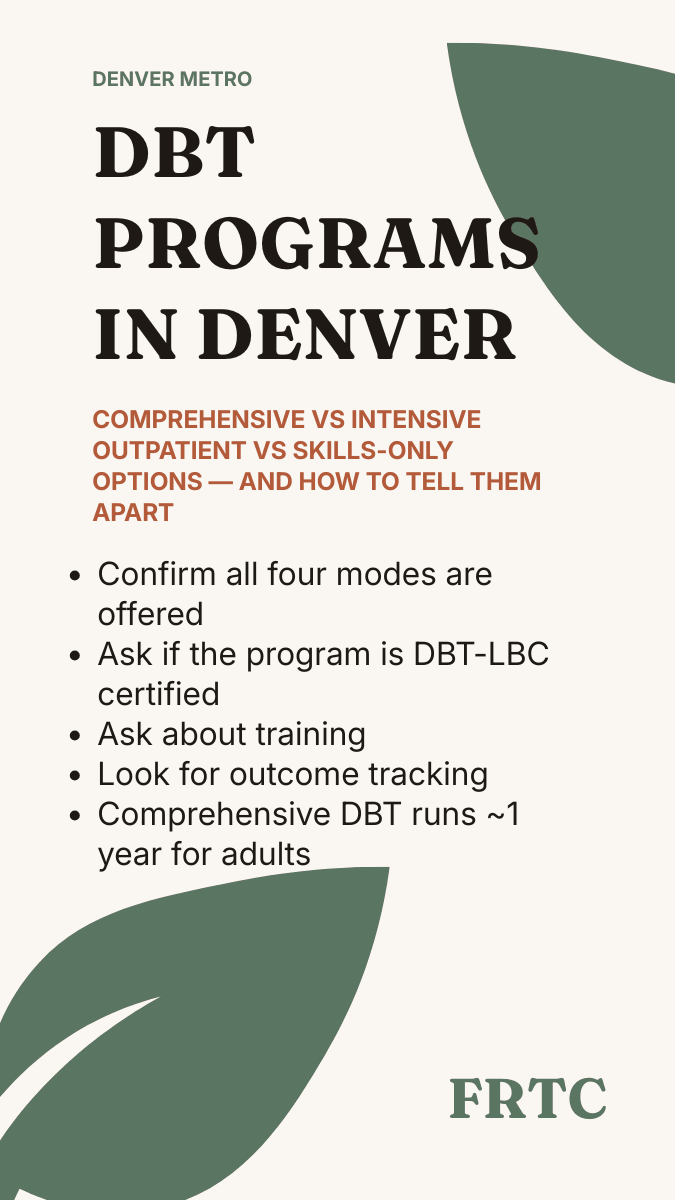
“Do you offer all four modes of DBT?” If the answer is anything other than individual therapy, skills group, phone coaching, and consultation team, it isn’t DBT, whatever it’s called. That’s worth knowing upfront.
“Is your program DBT-Linehan Board Certified?” The DBT-Linehan Board of Certification is the gold standard for DBT programs. Certified programs have been independently reviewed and verified to meet Dr. Linehan’s standards. There are a limited number of certified programs in any metro area, and certification is difficult to obtain. If a program has it, that’s a strong signal of quality.
“What training do your therapists have in DBT?” Look for therapists who have completed intensive DBT training (typically a 10-day foundational course plus ongoing consultation). Brief workshop attendance or self-study doesn’t provide the same depth.
“How long is the program?” Comprehensive DBT typically runs for at least one year for adults. Shorter programs exist (particularly for teens) but ask why it’s shorter and what the structure looks like.
“Do you track outcomes?” Good DBT programs use diary cards, behavioral tracking, and regular assessments to measure progress. If a program can’t tell you how they measure whether treatment is working, that’s a concern.
“What happens if I miss sessions?” Ask about the program’s attendance expectations. The 4-miss rule — where missing four consecutive weeks of individual therapy or four consecutive skills classes means leaving the program — is standard in comprehensive DBT. As originally written there are no exceptions; it exists to protect the integrity of treatment, not to punish you.
The Denver DBT Landscape
Denver has a range of options, from solo practitioners who list DBT among their approaches to multi-therapist practices offering the full model. Here’s how to navigate it:
University-affiliated programs sometimes offer DBT, often at lower cost. Wait lists can be long, but the supervision structure tends to be strong.
Group practices that specialize in DBT are more likely to offer the full model, since running a skills group requires multiple therapists and clients. A solo practitioner, no matter how well-trained, can’t run a consultation team alone.
Insurance considerations. Many comprehensive DBT programs operate out-of-network because insurance reimbursement doesn’t always cover the full model (especially phone coaching and consultation team time). Ask about superbills for out-of-network reimbursement, sliding scale options, and whether skills group fees are separate from individual therapy.
Online vs. in-person. Since the pandemic, many DBT programs offer hybrid or fully virtual options. Online DBT can be just as effective as in-person, especially for skills group. The key is whether you can maintain the consistency and engagement the program requires.
Red Flags to Watch For
Not every practice that lists DBT on its website is delivering it at a high level. Here are some warning signs:
- A therapist says they “do DBT” but doesn’t offer skills group or phone coaching
- No mention of a consultation team
- The program is significantly shorter than the standard (less than 6 months for adults) without a clear rationale
- No use of diary cards or structured outcome tracking
- The therapist becomes defensive when you ask about their training or the program structure
- The program can’t articulate how it handles crises between sessions
These don’t necessarily mean the therapy won’t be helpful, but they indicate you’re getting something other than comprehensive DBT.
The Role of the Therapist Consultation Team
One component that often gets overlooked in the search process is the therapist consultation team. Most clients never see this part of treatment, but it is arguably what separates a high-quality DBT program from one that drifts over time.
The consultation team is a weekly meeting where the therapists in the program consult with each other about their cases. They discuss what is working, what is not, where they feel stuck, and how to stay adherent to the DBT model. This is not case management — it is therapist-to-therapist support designed to prevent burnout, correct drift, and ensure that the treatment your therapist provides this month is as good as the treatment they provided six months ago.
Working with high-risk clients is emotionally demanding. Without the consultation team, even well-trained therapists can gradually shift toward either too much validation or too much push for change — losing the dialectical balance that makes DBT effective. The team provides accountability and recalibration.
When you are evaluating a program, asking about the consultation team tells you something important about whether the practice is invested in the long-term quality of its therapists’ work, not just the initial training they received.
What to Expect in Your First Few Months
Understanding the timeline of DBT can help set realistic expectations and prevent premature dropout. The first few weeks of a comprehensive program are typically focused on orientation — learning the rules of skills group, establishing the therapeutic relationship with your individual therapist, and beginning to learn mindfulness skills, which form the foundation for everything else.
The first skills module cycle takes roughly six months to complete, covering mindfulness, distress tolerance, emotion regulation, and interpersonal effectiveness. Most comprehensive programs cycle through the modules twice over the course of a year, which means you get two passes at each set of skills. The second pass is typically much more productive than the first because you have real-life experience to draw on.
During the first few months, it is common to feel like things are getting harder rather than easier. This is partly because you are becoming more aware of your patterns — the diary card helps with this — and partly because real change requires disrupting behaviors that have been serving a function, even if that function is unhealthy. Your individual therapist helps you navigate this period, and the phone coaching component ensures you have support between sessions when things feel most difficult.
By the midpoint of treatment, most clients report noticeable shifts: fewer crises, better communication in relationships, and a growing ability to tolerate emotions that used to feel unmanageable. By the end of a full year, the improvements tend to be substantial and self-sustaining.
Making Your Decision
Choosing a DBT program is ultimately about fit. The clinical structure matters — comprehensive DBT is the treatment the research supports, and a few skills aren’t a substitute for it — but so does your relationship with the therapist, the logistics (location, schedule, cost), and whether the program’s culture feels right for you.
If you can find a DBT-Linehan Board Certified program that you can access logistically and afford financially, that’s your strongest option. If not, look for a program that delivers all four modes of comprehensive DBT with therapists who have intensive DBT training.
And trust your instincts in the consultation. A good DBT program should feel structured, clear about expectations, and willing to answer every question you have.
DBT at Front Range Treatment Center
Front Range Treatment Center is a DBT-Linehan Board Certified program in the Denver Tech Center, offering the full comprehensive model for adults, teens, children, and couples. We also offer CBT programs for anxiety, depression, OCD, and trauma.
If you’re comparing programs and want to understand whether FRTC is the right fit, contact us for a free phone consultation. We’re happy to walk through exactly how our program works and help you make an informed choice — even if that choice ends up being a different practice.
Related Reading
Thinking about starting DBT?
We’re Colorado’s only DBT-Linehan Board Certified program — the full DBT treatment, not a few skills. Ask us anything about how it works or what it would look like for you.
Send a message →We usually reply within one business day. In a crisis, call or text 988.