How DBT Helps with Depression
How DBT treats depression through emotion regulation, behavioral activation, and mindfulness. A practical guide from Denver DBT therapists.
In this article
- Why Depression Is More Than “Feeling Sad”
- How DBT Approaches Depression
- Emotion Regulation
- Mindfulness
- Distress Tolerance
- Interpersonal Effectiveness
- DBT vs. Traditional Talk Therapy for Depression
- Who Benefits Most from DBT for Depression?
- What DBT for Depression Looks Like at FRTC
- Building a Life Worth Living
- Taking the First Step
- Related Reading
When most people think of Dialectical Behavior Therapy (DBT), they think of borderline personality disorder. That association makes sense — DBT was originally developed for BPD — but it sells the treatment short. DBT is also a powerful, evidence-based approach to depression — see our DBT for depression program — particularly when depression involves intense emotions, self-criticism, or a pattern of withdrawing from life.
If you’ve tried therapy for depression before and found it helpful but incomplete, or if your depression comes tangled up with emotional overwhelm, DBT may be the missing piece.
Why Depression Is More Than “Feeling Sad”
Depression isn’t a mood you can snap out of. It’s a clinical condition that changes how your brain processes motivation, pleasure, and energy. People experiencing depression often describe feeling hollow, heavy, or numb — not just sad. Daily tasks that used to feel automatic start requiring enormous effort.
Common symptoms include persistent low mood, loss of interest in things you used to enjoy, sleep disruption, fatigue, difficulty concentrating, and feelings of worthlessness. In more severe cases, depression brings thoughts of death or self-harm.
What makes depression especially difficult to treat is its self-reinforcing nature. Low energy leads to withdrawal, withdrawal leads to fewer positive experiences, and fewer positive experiences deepen the depression. Breaking that cycle requires more than insight — it requires skills.
How DBT Approaches Depression
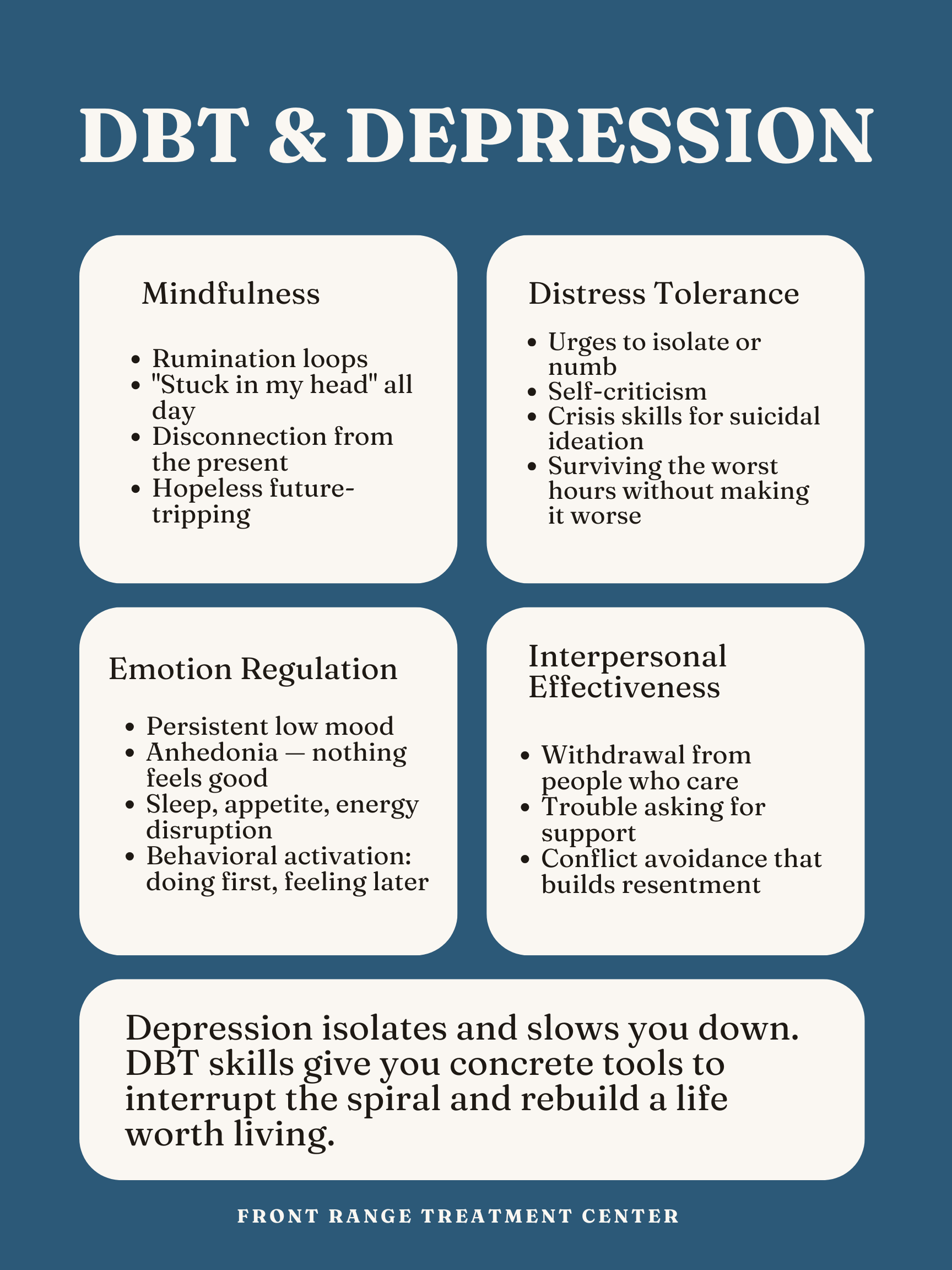
DBT treats depression by targeting the specific mechanisms that keep it going: emotion dysregulation, avoidance, and harsh self-judgment. It does this through four core skill modules.
Emotion Regulation
The emotion regulation module teaches you to understand your emotions rather than being controlled by them. For depression, several skills are particularly useful:
Opposite Action is one of the most effective DBT tools for depression. When depression tells you to stay in bed, cancel plans, and isolate, opposite action asks you to do the reverse — gently and deliberately. You get up, you show up, you re-engage. Not because you feel like it, but because the behavior itself changes the emotional trajectory.
Check the Facts helps you examine whether your depressive thoughts are accurate. Depression is a convincing liar. It tells you that nothing will help, that people don’t care, that you’re a burden. This skill teaches you to slow down, look at the evidence, and separate emotional reasoning from reality.
ABC PLEASE addresses the lifestyle foundations that depression erodes. Accumulating positive experiences, building mastery through small accomplishments, coping ahead for difficult situations, and taking care of your physical health (sleep, exercise, nutrition) — these aren’t luxuries. They’re the scaffolding that keeps depression from deepening.
Mindfulness
Mindfulness in DBT isn’t about relaxation or clearing your mind. It’s about learning to observe your thoughts and feelings without getting swept away by them. For someone with depression, this is critical.
Depression pulls you into the past (rumination) or the future (hopelessness). Mindfulness anchors you in the present moment — the only place where change is actually possible. Practicing non-judgmental awareness also helps counter the relentless self-criticism that depression generates.
Distress Tolerance
When depression becomes acute — when the pain feels unbearable and you just need to get through the next hour — distress tolerance skills provide a lifeline. Techniques like TIPP (Temperature, Intense exercise, Paced breathing, Paired muscle relaxation) offer rapid, physiological relief without making things worse.
Interpersonal Effectiveness
Depression damages relationships. You withdraw. You stop reaching out. You feel like a burden, so you pull away — which removes the social connection that could actually help. The interpersonal effectiveness module teaches you how to ask for what you need, set boundaries, and maintain relationships even when depression makes it feel impossible.
DBT vs. Traditional Talk Therapy for Depression
Standard Cognitive Behavioral Therapy (CBT) is the most well-researched treatment for depression, and it works well for many people. It focuses on identifying and restructuring negative thought patterns.
DBT overlaps with CBT but adds several layers that matter when depression is severe or chronic:
Skills-based structure. DBT doesn’t just talk about problems — it teaches specific, practicable skills in a structured group format. You leave each session with something concrete to use.
Validation alongside change. CBT leans heavily toward changing your thoughts. DBT balances that with validation — acknowledging that your suffering is real and understandable. For people whose depression is rooted in invalidation or trauma, this balance is essential.
Emotion focus. CBT targets cognition first, expecting emotions to follow. DBT works directly with emotions, which can be more effective when depression is driven by emotional intensity rather than distorted thinking alone.
Who Benefits Most from DBT for Depression?
DBT for depression tends to be most helpful when:
- Depression co-occurs with emotional intensity, mood swings, or difficulty managing feelings
- Standard therapy hasn’t produced lasting improvement
- Depression is accompanied by self-harm, suicidal thinking, or impulsive behavior
- There’s a history of invalidation or emotional neglect
- Depression comes alongside anxiety, BPD, or relationship difficulties
If your depression feels “straightforward” — a first episode triggered by a clear life event — CBT or behavioral activation alone may be sufficient. But if depression has been a recurring companion, or if it’s tangled up with other emotional struggles, DBT offers a more comprehensive approach.
What DBT for Depression Looks Like at FRTC
At Front Range Treatment Center, our comprehensive DBT program includes individual therapy, skills group, phone coaching, and a therapist consultation team — the full model as designed by Dr. Marsha Linehan. We also offer CBT-based depression treatment for clients who may benefit from a different approach.
During individual sessions, your therapist helps you apply DBT skills directly to your depressive patterns. In skills group, you learn and practice the four modules alongside others working on similar challenges. Phone coaching gives you real-time support when depression hits hard between sessions.
Treatment length varies, but most clients begin noticing meaningful shifts within two to three months. The skills you learn aren’t temporary coping strategies — they’re tools you’ll carry for life. Many clients find that even after completing the formal program, the skills continue to deepen as they apply them to new situations and challenges.
Building a Life Worth Living
This phrase — “a life worth living” — is central to DBT and especially relevant to depression treatment. Depression narrows your life. It convinces you that nothing will be enjoyable, so you stop trying. The world shrinks to work, sleep, and the bare minimum required to get through each day.
DBT directly counters this narrowing process. The ABC PLEASE skill explicitly asks you to accumulate positive experiences — not because you feel like it, but as a deliberate, strategic behavior. You schedule activities that have historically brought pleasure or mastery, even when depression insists they will be pointless. More often than not, once you are actually in the activity, the experience is better than depression predicted. Over time, these experiences accumulate and begin to shift the emotional baseline.
Building mastery is equally important. Depression attacks your sense of competence. It tells you that you cannot do anything well, that you are falling behind, that you are inadequate. Deliberately doing one thing each day that gives you a sense of accomplishment — however small — pushes back against that narrative with evidence. It does not have to be impressive by anyone else’s standards. Cooking a meal, completing a work task, showing up to skills group — these count.
The “life worth living” concept also extends to values clarification. Depression often disconnects people from their values — from the things that give life meaning beyond moment-to-moment pleasure. In individual DBT therapy, your therapist helps you reconnect with what matters to you and begin making choices that align with those values, even when depression makes everything feel equally meaningless.
This is where DBT for depression differs most from purely symptom-focused approaches. It does not just aim to reduce sadness or increase energy. It aims to help you build a life that generates its own reasons for engagement — a life where the symptoms of depression have less room to operate because the life itself provides counterweight.
Taking the First Step
Depression makes it hard to take action. That’s the nature of the illness. But reaching out — even when it feels pointless — is itself an act of opposite action. It’s the first skill in practice.
If you’re in the Denver area and wondering whether DBT might help with your depression, contact us for a free consultation. We’ll help you figure out whether DBT, CBT, or a combination is the best fit for where you are right now.
Related Reading
Thinking about starting DBT?
We’re Colorado’s only DBT-Linehan Board Certified program — the full DBT treatment, not a few skills. Ask us anything about how it works or what it would look like for you.
Send a message →We usually reply within one business day. In a crisis, call or text 988.