ABC PLEASE Skill in DBT
Learn how the ABC PLEASE skill from DBT helps you reduce vulnerability to intense emotions by building positive experiences and taking care of your body.
In this article
Most DBT skills are about what to do when emotions hit. ABC PLEASE is about reducing how often and how intensely they hit in the first place. It’s a preventive skill — part of the emotion regulation module — that targets the conditions that make you vulnerable to emotional crises.
Think of it this way: if you’re sleep-deprived, haven’t eaten, are avoiding things that matter to you, and haven’t done anything enjoyable in weeks, your emotional threshold is going to be low. Minor stressors will feel major. ABC PLEASE addresses this foundation.
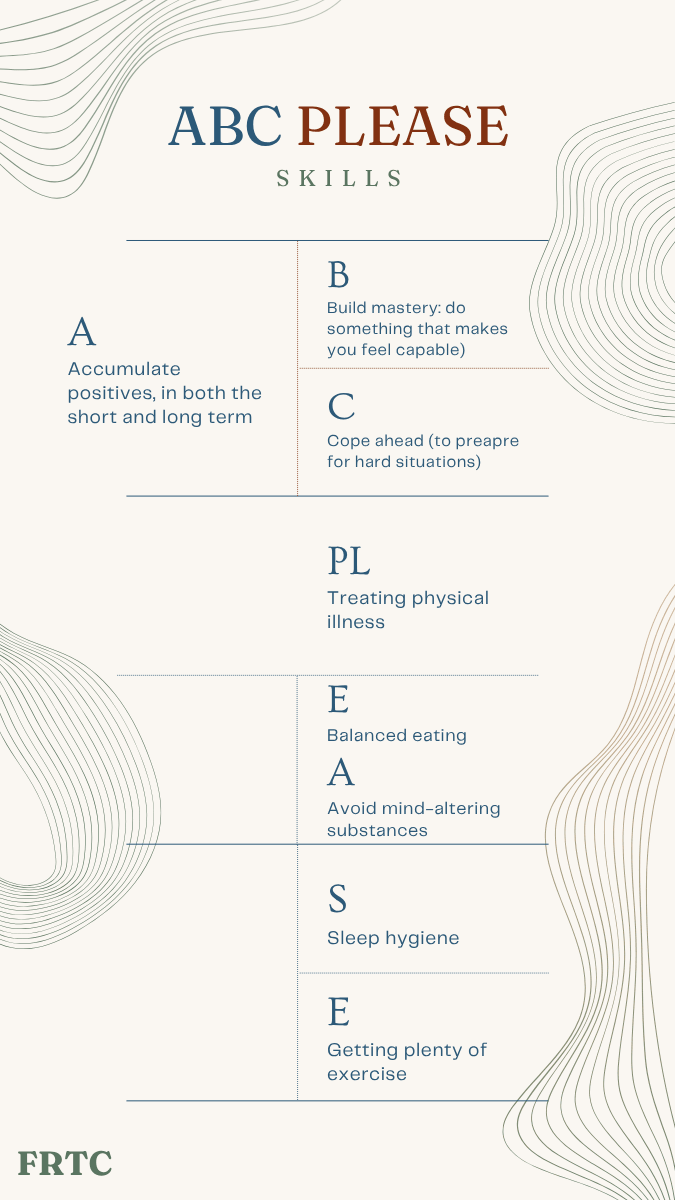
The ABC Part: Building a Life Worth Living
A — Accumulate Positive Experiences
Depression and emotional dysregulation shrink your world. Activities get dropped. Social connections fade. The things that used to bring joy get crowded out by distress. ABC PLEASE pushes back against this shrinkage.
Short-term: Do one pleasant thing every day. It doesn’t need to be big — a walk, a good meal, a phone call with someone you like, 20 minutes of a hobby. The goal is to build positive emotional data points that counter the negative ones.
Long-term: Identify your values and take steps toward goals that align with them. A life that feels meaningful is more emotionally resilient than one that feels empty, regardless of circumstances.
This isn’t about toxic positivity or pretending everything is fine. It’s about deliberately creating experiences that generate positive emotions, because positive emotions don’t just feel good — they expand your capacity to cope with the hard stuff.
B — Build Mastery
Do one thing each day that gives you a sense of competence. Learn something. Complete a task. Practice a skill. Make progress on a project.
Mastery experiences combat the helplessness that depression and emotional dysregulation create. When you accomplish something — even something small — your brain gets evidence that you’re capable. That evidence accumulates over time and shifts your self-perception.
The key is to calibrate difficulty. If the task is too easy, you won’t get a mastery experience. If it’s too hard, you’ll fail and feel worse. Choose something challenging enough to require effort but achievable enough that success is likely.
C — Cope Ahead
Cope ahead means preparing for emotionally difficult situations before they happen. If you know Thursday’s meeting is going to be stressful, plan how you’ll handle it. Mentally rehearse using your skills. Identify potential triggers and decide in advance how you’ll respond.
This works because most emotional derailments happen when we’re caught off guard. Cope ahead removes the surprise factor. You’ve already decided what to do, so when the moment arrives, you don’t have to figure it out under pressure.
Steps for cope ahead:
- Describe the situation you’re preparing for
- Identify the emotions you expect to feel
- Decide which skills you’ll use
- Mentally rehearse the whole sequence — the trigger, the emotion, and your skillful response
- Practice relaxation after the rehearsal
The PLEASE Part: Physical Self-Care
PLEASE targets the biological factors that make emotions harder to manage. Each letter represents a physical self-care priority:
PL — treat PhysicaL illness. If you’re sick, manage it. Take medications as prescribed. See doctors when needed. Physical pain and illness lower your emotional threshold.
E — balanced Eating. Eat regularly and adequately. Skipping meals causes blood sugar drops that directly affect mood and emotional reactivity. You don’t need a perfect diet — you need consistent, adequate nutrition.
A — Avoid mood-altering substances. Alcohol, recreational drugs, and excessive caffeine all destabilize emotions. This doesn’t have to mean total abstinence for everyone, but be honest about whether substances are making your emotional regulation harder.
S — balanced Sleep. Sleep is arguably the single most important factor in emotional regulation. Insufficient sleep impairs the prefrontal cortex — the brain region responsible for emotion regulation — and amplifies the amygdala’s reactivity. Prioritize 7-9 hours. Maintain consistent sleep and wake times. Protect the hour before bed from screens and stimulation.
E — Exercise. Regular physical activity is one of the most effective interventions for mood regulation. It reduces anxiety, improves depression, and builds stress resilience. The research supports as little as 20-30 minutes of moderate activity three times per week.
Why PLEASE Matters So Much
Many people skip PLEASE because it seems too basic. “I know I should sleep more and eat better. Tell me something I don’t know.”
But knowing and doing are different. And the impact of these basics on emotional regulation is enormous. A person who sleeps well, eats regularly, and exercises is fundamentally more emotionally resilient than the same person running on four hours of sleep and coffee.
PLEASE isn’t about perfection. It’s about reducing the number of vulnerability factors you’re carrying into each day. If you can improve even one or two of these areas, your emotional baseline shifts.
Putting It Together
ABC PLEASE works best as an ongoing practice, not a crisis intervention. It’s the maintenance that prevents breakdowns:
Daily: One pleasant experience, one mastery activity, regular meals, adequate sleep.
Weekly: Review your values and long-term goals. Are you taking steps toward them? Adjust if needed. Get your exercise.
Before difficult situations: Cope ahead. Rehearse your plan. Make sure your PLEASE basics are solid — don’t walk into a hard conversation after a night of bad sleep and no breakfast.
ABC PLEASE and Other DBT Skills
ABC PLEASE does not operate in isolation. It is the foundational skill that makes all other DBT skills more accessible and effective, and understanding how it connects to the broader toolkit helps you use it more strategically.
When your PLEASE foundations are strong — adequate sleep, regular nutrition, moderate exercise, and managed physical health — your emotional baseline is lower. This means that when a stressor hits, your starting point is a 3 rather than a 7, which gives you more room before reaching the intensity level where crisis skills become necessary. In practical terms, the person who slept well and ate breakfast can use opposite action for their anxiety; the person who is sleep-deprived and hungry may need TIPP for the same situation because their arousal is already elevated.
The accumulating positive experiences component connects directly to mindfulness. Many people with depression or emotional dysregulation have lost the ability to notice and savor positive moments — they are so practiced at scanning for threats that pleasant experiences pass unregistered. Mindfulness training helps you actually be present for the positive experiences you are accumulating rather than sleepwalking through them.
Cope ahead connects to the interpersonal effectiveness skills. Before a difficult conversation, you might cope ahead by planning your DEAR MAN — deciding in advance how you will describe the situation, express your feelings, and assert your needs. You might also rehearse using GIVE to maintain the relationship and FAST to protect your self-respect. This kind of preparation dramatically increases the likelihood of the conversation going well.
When PLEASE Feels Impossible
For people in the depths of depression, emotional crisis, or chaotic life circumstances, the PLEASE recommendations can feel laughably out of reach. Sleep well? You have insomnia. Exercise? You cannot get out of bed. Eat regularly? You have no appetite. Avoid substances? Alcohol is the only thing that quiets the noise.
This is a real tension, and it is important to address it honestly rather than dismissing it. The answer is not to do all of PLEASE perfectly right away. The answer is to pick one thing — the one that seems most achievable — and work on it incrementally. If you are sleeping four hours a night, the goal is not immediately sleeping eight. It is improving to five, then six, building gradually.
Your DBT therapist can help you identify which PLEASE factor is most impacting your emotional regulation and create a realistic plan for addressing it. Sometimes the order matters: improving sleep often has cascading effects on mood, energy, and motivation that make the other changes easier. Other times, adding one pleasant experience per day is the most achievable starting point and creates the momentum for other changes.
The critical insight is that PLEASE is not about perfection — it is about reducing vulnerability factors one at a time. Even small improvements compound over weeks and months, shifting your emotional baseline in ways that make everything else in treatment more effective. Many clients report that the first PLEASE factor they address creates a momentum that makes the next ones feel more achievable — a positive cycle that gradually replaces the negative one.
At Front Range Treatment Center, ABC PLEASE is taught as part of our emotion regulation skills group. It’s the skill that makes all the other skills work better — because when your foundation is solid, everything built on top of it is more stable.
Related Reading
Want to learn these skills properly?
Reading about a skill and practicing it with a trained DBT therapist are different things. Our skills classes run the full Linehan curriculum alongside individual therapy.
Send a message →We usually reply within one business day. In a crisis, call or text 988.