7 Common Myths About DBT
Debunking 7 common myths about dialectical behavior therapy. Learn what DBT really is and who can benefit from this evidence-based treatment.
In this article
- Myth 1: DBT Is Only for Borderline Personality Disorder
- Myth 2: DBT Is Just About Learning to Cope
- Myth 3: DBT Skills Group Is Like Group Therapy
- Myth 4: DBT Tells You to Just Accept Everything
- Myth 5: DBT Takes Too Long and Requires Too Much Time
- Myth 6: Any Therapist Who Uses DBT Skills Is Doing DBT
- Myth 7: DBT Is Not Evidence-Based
- The Bottom Line
- Related Reading
Dialectical Behavior Therapy (DBT) is one of the most well-researched and effective forms of psychotherapy available today, yet misconceptions about it remain surprisingly common. Whether you are exploring treatment options for yourself or trying to understand a loved one’s care, having accurate and up-to-date information matters. Below we address seven of the most widespread myths about DBT, explain where they come from, and clarify what the evidence actually shows.
Myth 1: DBT Is Only for Borderline Personality Disorder
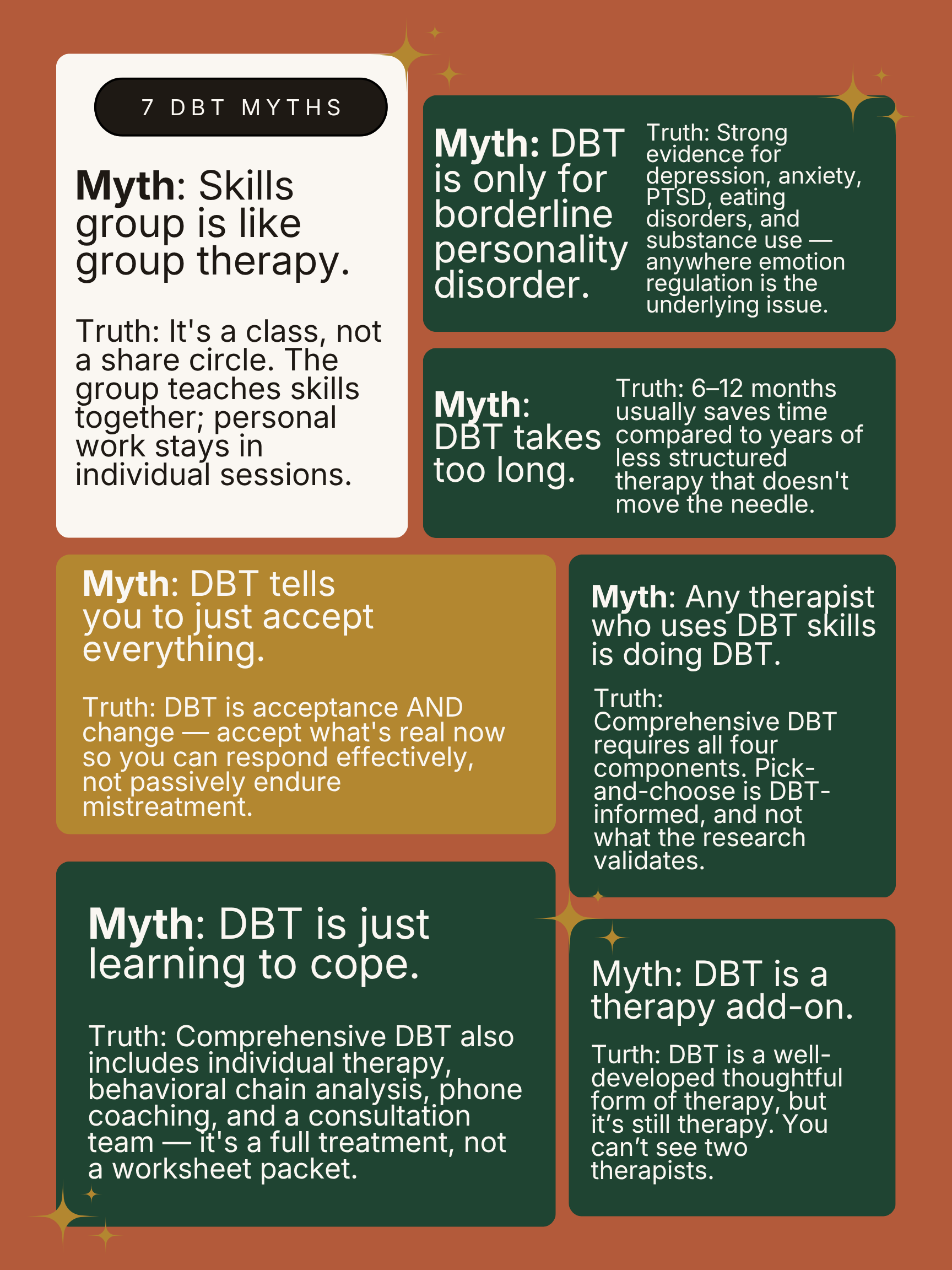
While Dr. Marsha Linehan originally developed DBT to treat borderline personality disorder (BPD), decades of research have since demonstrated its effectiveness for a much broader range of conditions. DBT has strong evidence supporting its use for depression, anxiety disorders, eating disorders, substance use disorders, PTSD, and emotion dysregulation in general.
The reason DBT works for so many conditions is that emotion dysregulation — the core problem it targets — cuts across diagnostic categories. Someone with treatment-resistant depression often struggles with emotion regulation just as much as someone with BPD. The skills are the same; the application is what changes. At Front Range Treatment Center, we work with clients facing a wide variety of challenges — you do not need a BPD diagnosis to benefit from DBT.
Myth 2: DBT Is Just About Learning to Cope
Skills training is a major component of DBT, but the treatment is far more than a list of coping techniques. Comprehensive DBT includes weekly individual therapy where you and your therapist work on the specific issues driving your suffering. It also includes phone coaching for real-time support and a therapist consultation team that helps your treatment providers stay effective and motivated. The skills you learn in group — mindfulness, distress tolerance, emotion regulation, and interpersonal effectiveness — are integrated into every part of this larger treatment framework.
In individual therapy, your therapist uses tools like behavioral chain analysis to understand exactly what leads to problematic behaviors and what maintains them. This isn’t just “coping” — it’s a systematic process of understanding your patterns, identifying where change is possible, and building a life that generates fewer crises in the first place. The skills are essential, but they’re one piece of a comprehensive treatment that addresses motivation, behavioral patterns, and the therapeutic relationship itself.
Myth 3: DBT Skills Group Is Like Group Therapy
Many people feel anxious about the group component of DBT because they imagine sitting in a circle sharing deeply personal stories. In reality, DBT skills group functions more like a classroom. The group leader teaches a specific skill, the group practices it together, and members share homework from the previous week. You are not expected to disclose your personal history or discuss the details of your struggles in front of others. The personal work happens in your individual therapy sessions.
The group format serves an important function beyond just teaching skills. Learning alongside others who are working on similar challenges normalizes the experience and reduces shame. When you hear another group member describe how they used distress tolerance skills to get through a difficult week, it reinforces that these tools work in real life, not just in theory. Many people who were initially reluctant about the group component end up describing it as one of the most valuable parts of their treatment.
Myth 4: DBT Tells You to Just Accept Everything
The word “dialectical” in DBT refers to the balance between acceptance and change. DBT does not ask you to passively accept a painful situation and do nothing about it. Instead, it teaches radical acceptance — acknowledging reality as it is in this moment — while simultaneously working to change the things that need changing. This balance is at the heart of DBT and is what makes the treatment so effective. You learn to stop fighting reality in ways that increase your suffering and redirect that energy toward meaningful change.
Consider a practical example. If you’re in a relationship that’s causing you pain, radical acceptance doesn’t mean accepting the mistreatment. It means accepting the reality of the situation — “this is what’s happening right now” — so you can respond effectively rather than being paralyzed by denial, rage, or despair. Acceptance clears the emotional fog so you can actually make a good decision about what to change and how.
Myth 5: DBT Takes Too Long and Requires Too Much Time
It is true that comprehensive DBT asks for a meaningful time commitment — typically one individual session and one skills group per week, plus homework practice. However, this structure exists because it works. Research consistently shows that the combination of individual therapy and skills training produces better outcomes than either one alone. Many clients begin noticing real changes within the first few months, and a standard course of treatment is about a year.
The time commitment concern is understandable, but it’s worth putting in context. Many people who come to DBT have already spent years in less structured therapy without achieving lasting change. They’ve tried weekly sessions with various therapists, tried medications alone, or attempted to manage on their own — and the problems persist. Compared to years of cycling through less effective treatments, DBT’s focused, time-limited approach often saves time in the long run. The investment is real, but so are the measurable results.
Myth 6: Any Therapist Who Uses DBT Skills Is Doing DBT
There is an important difference between comprehensive DBT and a therapist who uses a few DBT skills. Many therapists incorporate a few DBT techniques into their practice, but comprehensive DBT is a structured program with specific requirements: individual therapy, skills group, phone coaching, and a therapist consultation team. When looking for a DBT provider, it helps to ask whether they offer all four components.
This distinction has real consequences. The research demonstrating DBT’s effectiveness was conducted using the comprehensive model with all four components in place. When therapists pick and choose elements — teaching a few mindfulness exercises here, using a diary card there — they may be providing helpful treatment, but it’s not the treatment the evidence supports. For serious conditions like BPD or chronic suicidality, the difference between comprehensive and informed can be the difference between transformation and incremental improvement.
Front Range Treatment Center is a DBT-Linehan Board Certified program, which means our program has been independently verified to meet the standards set by the treatment’s developer. DBT-LBC certification is the clearest way for consumers to know they’re receiving the real thing.
Myth 7: DBT Is Not Evidence-Based
DBT is one of the most extensively studied psychotherapies in existence. It has been evaluated in dozens of randomized controlled trials — the gold standard of clinical research — across multiple countries and populations. Studies have consistently shown that DBT reduces self-harm, suicidal behavior, depression, and hospitalizations while improving quality of life and emotional well-being. The Substance Abuse and Mental Health Services Administration (SAMHSA) recognizes DBT as an evidence-based practice, and it is recommended in treatment guidelines worldwide.
The evidence is particularly strong for BPD, where comprehensive DBT has been shown to reduce self-harm by approximately 50% and lead to remission of the diagnosis in the majority of participants. But the science behind DBT extends well beyond BPD — controlled trials have demonstrated its effectiveness for treatment-resistant depression, eating disorders, substance use disorders, and PTSD. Very few psychotherapies in existence have this breadth of research support.
The Bottom Line
Misinformation about DBT can prevent people from accessing a treatment that might genuinely change their lives. Each of these myths — that it’s only for BPD, that it’s just coping skills, that the group is scary, that it’s all about acceptance, that it takes too long, that any therapist can do it, or that it lacks evidence — creates a barrier between someone who is suffering and a treatment that could help. The more accurately people understand what DBT actually is, the better equipped they are to make informed decisions about their care.
If you or someone you care about is struggling with intense emotions, difficult relationships, or behaviors that feel out of control, DBT may be worth exploring. Front Range Treatment Center offers comprehensive, certified DBT for adults, teens, and children in the Denver metro area. Contact us to schedule a free consultation and learn whether DBT is right for you. We’re always happy to answer questions about what DBT involves, how it differs from other approaches, and what you can realistically expect from treatment.
Related Reading
Thinking about starting DBT?
We’re Colorado’s only DBT-Linehan Board Certified program — the full DBT treatment, not a few skills. Ask us anything about how it works or what it would look like for you.
Send a message →We usually reply within one business day. In a crisis, call or text 988.