Psilocybin Therapy in Colorado
A complete guide to legal psilocybin therapy in Colorado — the three-phase process, who it's for, safety screening, costs, and what to expect.
In this article
- What Is Psilocybin-Assisted Therapy?
- The Legal Framework: Colorado’s Natural Medicine Health Act
- The Three Phases of Psilocybin-Assisted Therapy
- Phase 1: Preparation
- Phase 2: Administration
- Phase 3: Integration
- Who Is Psilocybin-Assisted Therapy For?
- Who Should NOT Pursue Psilocybin Therapy?
- What Does It Cost?
- How Psilocybin Therapy Connects With DBT and Other Treatments
- How to Get Started
- Related Reading
Colorado became the second state in the nation to legalize regulated psilocybin services when voters passed Proposition 122 in November 2022. Since then, the state has built a licensing and regulatory framework, healing centers have opened their doors, and a growing number of Coloradans are exploring psilocybin-assisted therapy for depression, anxiety, trauma, and personal growth.
But knowing that something is legal and knowing what it actually looks like are two very different things. If you’re considering psilocybin-assisted therapy, the most important question is also the simplest: what should I expect?
This guide walks through the entire process — from first phone call to weeks after your session — so you can make an informed decision about whether this is right for you. For a focused look at the session day itself, see what happens in a session.
What Is Psilocybin-Assisted Therapy?
Psilocybin is a naturally occurring compound found in certain species of mushrooms. When ingested, it converts to psilocin in the body and interacts with serotonin receptors in the brain. At therapeutic doses, it produces altered states of consciousness that often include heightened emotional openness, shifts in perspective, and experiences that many people describe as deeply meaningful.
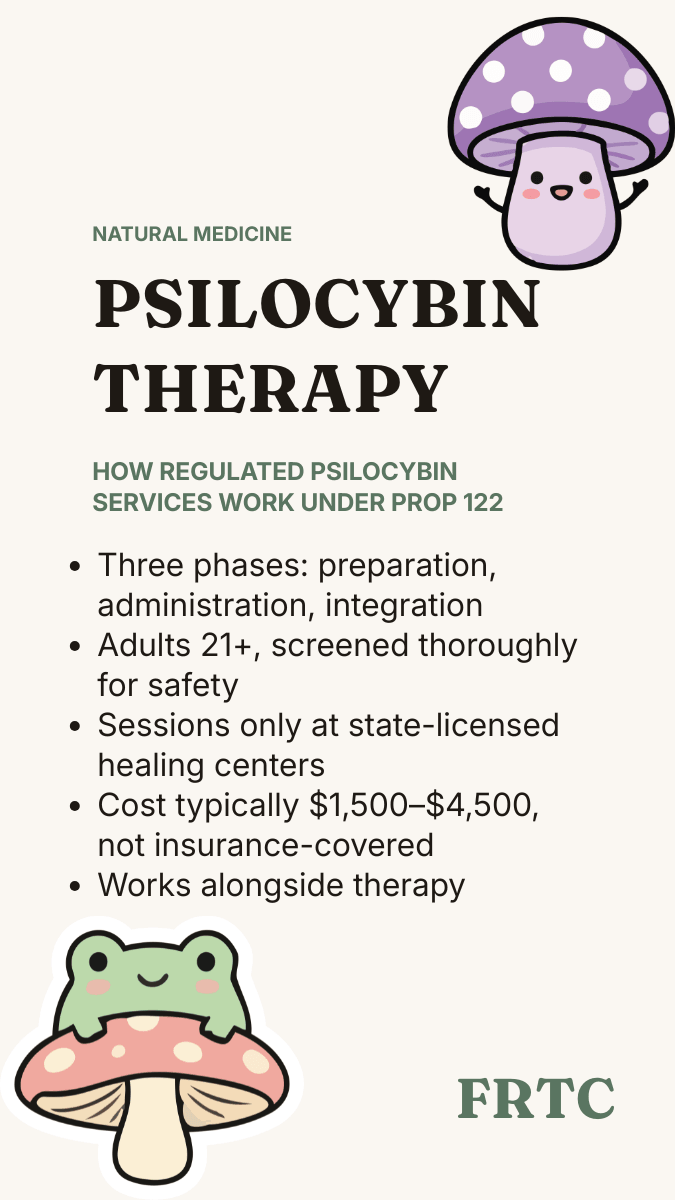
What makes this therapy rather than recreational use is the structure surrounding it. In Colorado’s regulated model, psilocybin is administered in a state-licensed healing center by a trained, licensed facilitator. The experience is preceded by preparation sessions and followed by integration sessions — a clinical framework designed to make the experience as safe and therapeutically useful as possible.
Psilocybin is generally considered non-addictive. Decades of research at institutions like Johns Hopkins, NYU, and Imperial College London have demonstrated its potential for treating depression, anxiety, PTSD, substance use disorders, and end-of-life distress.
The Legal Framework: Colorado’s Natural Medicine Health Act
Before diving into the process, it helps to understand the legal landscape. Colorado’s Natural Medicine Health Act (Proposition 122) established a regulated system for psilocybin services that went into effect in 2025. Here are the key points:
Who can provide services: Only state-licensed facilitators and clinical facilitators may administer psilocybin. Facilitators complete rigorous training programs and are licensed through the Colorado Department of Regulatory Agencies (DORA). Clinical facilitators are additionally qualified to work with participants who have identified mental health conditions.
Where sessions happen: Administration sessions must take place in a state-licensed healing center. These are dedicated therapeutic spaces — not homes, offices, or retreat centers operating outside the regulatory framework.
Who can participate: Adults 21 and older who pass a safety screening. There is no requirement for a clinical diagnosis — some people pursue psilocybin services for personal growth, grief processing, or existential exploration.
What about other substances? Until June 1, 2026, “natural medicine” in Colorado refers only to psilocybin and psilocin. After that date, the Department of Natural Medicine may add other substances such as DMT, ibogaine, and mescaline to the regulated framework.
What is NOT legal: Retail sales of psilocybin, take-home products, and unregulated or unlicensed facilitation. The entire model is built around supervised, in-person therapeutic experiences.
The Three Phases of Psilocybin-Assisted Therapy
Psilocybin-assisted therapy is not a single event — it’s a process with three distinct phases. Each phase serves a specific purpose, and skipping any of them significantly reduces the likelihood of a beneficial outcome.
Phase 1: Preparation
Preparation involves one session with your facilitator before the psilocybin session, with additional sessions available if needed. This is where the therapeutic relationship begins and where the foundation for a safe experience is built.
During preparation, your facilitator will:
Complete a comprehensive safety screening. This includes a detailed review of your medical history, psychiatric history, family history, and current medications. Psilocybin is generally not recommended for individuals with a personal or family history of psychosis, schizophrenia, or certain other psychiatric conditions. Medications are also reviewed carefully — particularly SSRIs, MAOIs, and lithium, which can interact with psilocybin. Your facilitator will coordinate with your prescriber if medication questions arise. Never adjust medications on your own.
Help you set intentions. What are you hoping to explore, process, or understand? Intentions aren’t rigid goals — they’re more like compass points. They might be as specific as “I want to understand why I keep sabotaging my relationships” or as open as “I want to be more present in my life.”
Prepare you for the experience itself. Your facilitator will walk you through what the session day looks like, what kinds of experiences are common, and how to navigate difficult moments if they arise. You’ll develop a safety plan together and discuss grounding techniques. This preparation significantly reduces anxiety going into the session and gives you tools to work with whatever comes up.
Build rapport. The therapeutic relationship matters enormously in this context. You’ll be in a vulnerable, altered state for several hours. Feeling genuinely safe with and trusting of your facilitator isn’t optional — it’s a prerequisite for meaningful work.
Phase 2: Administration
The administration session is the psilocybin experience itself. Here’s what the day typically looks like:
Arrival and settling in. You arrive at the healing center and settle into a comfortable space — typically a private room designed for the experience, with comfortable seating or a mat, blankets, and a calm environment. Your facilitator is present throughout.
Ingestion. You ingest the psilocybin. The product is state-regulated, tested, and provided at the healing center. You do not bring your own.
The experience. The full administration session lasts up to seven hours. Effects typically begin within 30–60 minutes, with the active experience lasting four to six hours and additional time for arrival, settling in, and coming down. What happens during this window varies widely from person to person and session to session. Some people experience vivid imagery, emotional release, or a sense of deep interconnection. Others encounter difficult material — grief, fear, memories they’ve been avoiding. Some sessions are quiet and contemplative. There is no “right” way for a psilocybin experience to unfold.
Your facilitator provides non-directive support throughout. They’re not guiding you through a structured protocol or asking questions. They’re present, grounding, and responsive — there if you need them, quiet if you don’t. Eye shades and music are commonly used to support an inward-focused experience. You are never left alone.
Coming down and transition. As the effects ease, you’ll have time to rest, orient yourself, and talk briefly with your facilitator about what emerged. You will not be rushed.
Going home. You must arrange for someone you trust to drive you home. Plan to rest for the remainder of the day. No driving until the following day. Most people feel tired but emotionally open in the hours after a session.
Phase 3: Integration
Integration is often described as “where the real work happens.” A psilocybin session can surface powerful insights, emotions, and perspectives — but without deliberate follow-up, those insights often fade within days or weeks.
Integration sessions (typically one included, with additional sessions recommended) help you:
Make meaning from the experience. What did you encounter? What surprised you? What patterns or themes emerged? Your facilitator helps you identify the signal in what can feel like a chaotic or overwhelming experience.
Connect insights to daily life. Insight alone doesn’t produce change — behavior change does. Integration sessions help you translate what you experienced into concrete shifts in how you think, relate, and act. This is where skills from other therapeutic modalities become especially valuable. If you’re also working with a therapist trained in DBT or CBT, integration can be woven into your existing therapeutic work.
Process difficult material. Not every psilocybin experience is pleasant. Some sessions surface painful memories, unresolved grief, or uncomfortable truths. Integration provides a safe container for working through that material with professional support.
Plan next steps. Do you want additional integration sessions? Should your existing therapist be looped in? Are there behavioral changes you want to commit to? Integration is where you make a plan and build accountability.
Who Is Psilocybin-Assisted Therapy For?
Research suggests psilocybin-assisted therapy may benefit adults experiencing:
- Depression, including treatment-resistant depression that hasn’t responded to conventional medication or talk therapy
- Anxiety, particularly generalized anxiety and anxiety related to serious medical conditions
- PTSD and trauma, especially when other approaches have plateaued
- Substance use challenges, including alcohol and tobacco dependence
- End-of-life distress and existential anxiety
- Grief and loss that feels stuck or unresolved
- Personal growth — some people pursue psilocybin services without a clinical diagnosis, seeking deeper self-understanding or a shift in perspective
It’s worth noting that psilocybin-assisted therapy works particularly well alongside ongoing therapeutic work. If you’re already engaged in therapy — whether skills-based work like DBT, CBT, or another modality — psilocybin can deepen and accelerate that process rather than replacing it. The combination of psilocybin’s capacity to surface emotional material and therapy’s capacity to help you process and integrate it is where the most lasting change tends to happen.
Who Should NOT Pursue Psilocybin Therapy?
Psilocybin is not appropriate for everyone, and responsible facilitators will screen carefully. It is generally not recommended for:
- Individuals with a personal or family history of psychosis, schizophrenia, or schizoaffective disorder
- People currently taking lithium, which can interact dangerously with psilocybin
- Those on MAOIs, which can amplify psilocybin’s effects unpredictably
- People taking SSRIs or SNRIs, which may blunt or complicate the experience (this requires a nuanced conversation with your prescriber and facilitator — it’s not an automatic disqualifier, but it must be carefully evaluated)
- Anyone in an acute mental health crisis — stabilization should come first
- Individuals with certain cardiovascular conditions, as psilocybin can transiently increase heart rate and blood pressure
A thorough screening process exists precisely to catch these contraindications. If a facilitator doesn’t screen you carefully, that itself is a red flag.
What Does It Cost?
The complete natural medicine services package at FRTC is $3,000. This includes one preparation session, the administration session (up to seven hours, with your facilitator present throughout), one integration session, and all psilocybin product and healing center costs. Additional preparation or integration sessions are available at $175 each. Couples can journey together in one shared session for $5,000, and small groups of three or more are $2,000 per person. For full pricing details, see our natural medicine services page.
This is not currently covered by insurance. Some facilitators offer payment plans or sliding-scale options.
The cost reflects the reality of the service: your facilitator is with you for an entire day during the administration session, the healing center must meet state licensing requirements, and the psilocybin product itself is regulated and tested. When you compare this to the cumulative cost of years of medication management or multiple rounds of therapy that haven’t addressed the root issue, the value proposition becomes clearer — though we recognize it’s still a significant investment.
How Psilocybin Therapy Connects With DBT and Other Treatments
One question we hear frequently at FRTC: does psilocybin-assisted therapy replace my regular therapy?
The short answer is no — and we wouldn’t want it to. Psilocybin-assisted therapy and evidence-based modalities like DBT and CBT serve complementary functions.
Psilocybin excels at creating openings — moments of clarity, emotional breakthroughs, shifts in perspective that might take months or years to reach through talk therapy alone. But openings without skills to sustain them can close just as quickly.
That’s where ongoing therapeutic work comes in. DBT skills — mindfulness, distress tolerance, emotion regulation, interpersonal effectiveness — give you the toolkit to act on what psilocybin reveals. The insight might come in a single afternoon. The integration happens over months, with the support of skills and therapeutic structure.
This is one of the reasons FRTC offers both: we believe the most powerful outcomes come from combining breakthrough experiences with the daily practice of evidence-based skills.
How to Get Started
If you’re considering psilocybin-assisted therapy in Colorado, here’s a practical starting point:
Educate yourself. You’re already doing this. Understanding the process, the legal framework, and the realistic expectations is the most important first step.
Talk to your existing therapist. If you’re currently in therapy, discuss your interest openly. Your therapist can help you evaluate whether the timing is right and how to integrate the experience into your existing treatment.
Choose a licensed facilitator carefully. Verify their license through DORA’s lookup tool. Ask about their training, their approach, and their screening process. A facilitator who doesn’t screen thoroughly or who promises specific outcomes is not someone you should work with.
Reach out for a consultation. At FRTC, we offer consultations to help you determine whether natural medicine services are a good fit for your situation. We’ll discuss your history, your goals, and any questions you have — with no pressure to proceed.
Traveling from out of state? You don’t need to be a Colorado resident to access psilocybin-assisted therapy. Preparation and integration sessions are available via telehealth, so you only need to travel to Colorado for the administration session itself. See our guide for out-of-state clients for travel logistics and what to plan for.
Plan for the full process. Don’t think of this as a one-time event. The preparation matters. The integration matters. The ongoing therapeutic work matters. The people who get the most out of psilocybin-assisted therapy are the ones who take the entire process seriously.
FRTC offers psilocybin-assisted therapy as part of our natural medicine services in Denver, Colorado. All services are provided by a state-licensed facilitator in a state-approved healing center, in full compliance with Colorado’s Natural Medicine Health Act. To learn more or schedule a consultation, send us a message.
Related Reading
Considering psilocybin-assisted work?
FRTC provides natural medicine services through state-licensed facilitators under Colorado’s Natural Medicine Health Act. The first step is a conversation about whether this is appropriate for you — including when it isn’t.
Send a message →We usually reply within one business day. In a crisis, call or text 988.