Denver Mental Health Resources
A comprehensive guide to mental health resources in the Denver metro area. Therapy options, crisis lines, support groups, sliding scale providers, and more.
In this article
- Crisis Resources
- Evidence-Based Therapy
- DBT (Dialectical Behavior Therapy)
- CBT (Cognitive Behavioral Therapy)
- Exposure Therapy
- Finding Affordable Therapy
- Support Groups
- Specialized Populations
- Teens and Young Adults
- Veterans
- LGBTQ+ Community
- Medication Management
- How to Start
- Navigating Insurance and Out-of-Network Benefits
- Self-Help and Digital Resources
- What to Do If You Are Unsure Where to Start
- Related Reading
Finding mental health support in Denver can feel overwhelming. There are hundreds of providers, multiple systems to navigate, and it’s hard to know where to start — especially when you’re already struggling. This guide organizes the key resources by category so you can find what you need without the runaround.
Crisis Resources
If you or someone you know is in immediate danger, call 911. For mental health crisis support:
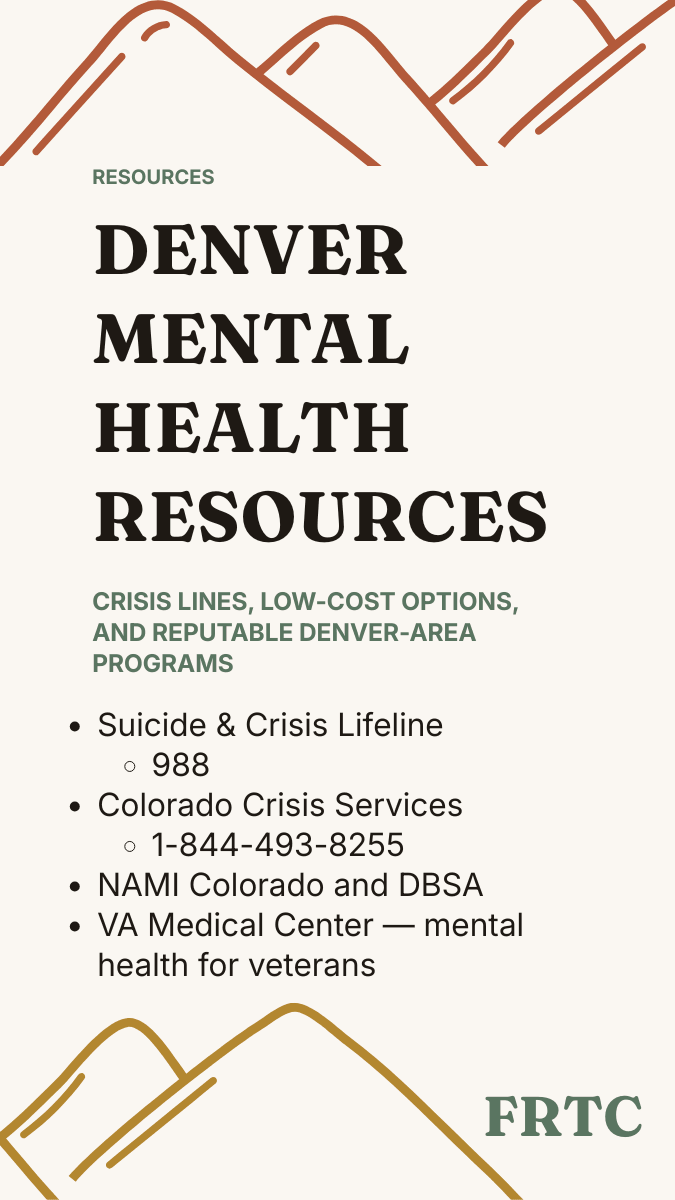
988 (Colorado Mental Health Line) — Call or text 988. Free, confidential, and available 24/7. In Colorado, 988 connects you to the Colorado Mental Health Line, which replaced Colorado Crisis Services in 2025 (the old number now routes to it). Serves anyone in emotional distress, not just those who are suicidal.
Walk-in crisis centers — Immediate in-person support, with Denver-area locations in Aurora, Denver, Wheat Ridge, and Littleton. Find a walk-in center.
Denver CARES — Denver’s acute detox and crisis stabilization facility for adults experiencing substance-related or mental health crises.
These services are free and available regardless of insurance status.
Evidence-Based Therapy
For ongoing mental health treatment, the most important factor is finding a therapist who uses evidence-based approaches — treatments that have been scientifically studied and shown to work.
DBT (Dialectical Behavior Therapy)
Best for: emotional dysregulation, BPD, self-harm, chronic suicidality, intense relationship conflict.
DBT is a structured program with individual therapy, skills groups, phone coaching, and a consultation team. It’s especially effective when emotions feel unmanageable and other therapies haven’t worked.
At Front Range Treatment Center, we offer comprehensive, DBT-LBC certified DBT for adults, teens, children, couples, and families in the Denver Tech Center and online throughout Colorado.
CBT (Cognitive Behavioral Therapy)
Best for: anxiety disorders, depression, OCD, PTSD, phobias, insomnia.
CBT is the most widely researched psychotherapy. It focuses on identifying and changing thought patterns and behaviors that maintain psychological distress. Most CBT treatments are structured and time-limited (12-20 sessions). FRTC offers condition-specific CBT tracks including anxiety treatment, depression treatment, OCD treatment, and trauma therapy.
Exposure Therapy
Best for: OCD, phobias, social anxiety, PTSD.
A specific form of CBT that involves systematically facing feared situations or stimuli. Exposure and Response Prevention (ERP) is the gold standard for OCD.
Finding Affordable Therapy
Cost is one of the biggest barriers to mental health care. Denver has several options for affordable treatment:
Community mental health centers. Denver has several federally qualified health centers that offer mental health services on a sliding fee scale based on income. These include the Mental Health Center of Denver and AllHealth Network.
Training clinics. Universities with graduate psychology or counseling programs (University of Denver, University of Colorado Denver, Naropa University) operate training clinics where advanced students provide therapy under supervision at reduced rates.
Health First Colorado (Medicaid). If you qualify for Medicaid in Colorado, mental health services are covered — administered through the regional accountable entity (RAE) assigned to your county. Some specialized programs accept only certain RAEs; FRTC accepts Colorado Access and Rocky Mountain Health Plans (RMHP).
Open Path Collective. An online directory of therapists who offer sessions at reduced rates ($30-$80) for people without adequate insurance coverage.
Sliding scale providers. Many private practice therapists offer sliding scale fees. Ask directly — it’s a standard question that therapists expect and welcome.
Support Groups
Peer support complements professional treatment and provides community:
NAMI Colorado (National Alliance on Mental Illness). Offers free support groups for people living with mental health conditions and their family members. Groups meet throughout the Denver metro area and online.
DBSA (Depression and Bipolar Support Alliance). Peer-led support groups for people living with depression or bipolar disorder. Free and confidential.
Al-Anon and Nar-Anon. Support for family members affected by a loved one’s substance use. Multiple meetings throughout Denver.
PFLAG Denver. Support for LGBTQ+ individuals and their families, with a focus on mental health and community connection.
Specialized Populations
Teens and Young Adults
Adolescent mental health requires age-appropriate treatment. Teen DBT programs and adolescent-specialized therapists understand the developmental context that shapes teen mental health. FRTC offers DBT specifically adapted for adolescents, with parent involvement built into the program.
Veterans
The Denver VA Medical Center provides comprehensive mental health services for veterans, including PTSD treatment, substance use programs, and crisis support. The Veterans Crisis Line is available at 988 (press 1).
LGBTQ+ Community
The Center on Colfax offers mental health support groups and referrals specifically for the LGBTQ+ community. When seeking a therapist, look for providers who demonstrate competence in LGBTQ+ issues, not just tolerance.
Medication Management
For some conditions, therapy works best in combination with medication. Psychiatrists (MDs) and psychiatric nurse practitioners can prescribe and manage psychotropic medications. Your primary care doctor can handle straightforward cases (like uncomplicated depression or anxiety), but complex medication management benefits from a specialist.
Denver has a shortage of psychiatrists, and wait times can be long. If you need medication management, ask your therapist for referrals — many have established relationships with prescribers and can expedite the process.
How to Start
The hardest part of getting help is often the first phone call. Here’s a simple framework:
- Identify what you’re dealing with. You don’t need a diagnosis — just a general sense of the problem (anxiety, depression, relationship issues, emotional intensity, etc.)
- Determine your budget and insurance. Know what you can afford and what your insurance covers.
- Call 2-3 providers. Ask about their approach, experience with your issue, availability, and fees. Most offer free initial consultations.
- Trust your gut. The therapeutic relationship matters. If a provider doesn’t feel right, keep looking.
If you’re not sure where to start and think DBT or CBT might be a good fit, Front Range Treatment Center offers free phone consultations. We’re happy to help you figure out whether our programs match your needs — or to point you toward a better resource if they don’t.
Navigating Insurance and Out-of-Network Benefits
Insurance coverage for mental health services in Colorado has improved significantly in recent years, but navigating the system remains confusing. Here are some things worth knowing.
Mental health parity laws require insurance companies to cover mental health treatment at the same level as physical health treatment. In practice, this means your plan cannot impose more restrictive limits on therapy visits than it does on medical visits, and copays for mental health should be comparable to those for medical care.
In-network vs. out-of-network. Many specialized providers — particularly those offering comprehensive DBT programs — operate out-of-network because insurance reimbursement does not adequately cover the full DBT model. However, most insurance plans offer out-of-network benefits that reimburse a percentage of therapy costs. Ask your insurance company about your out-of-network mental health benefits, your deductible, and the reimbursement rate for outpatient psychotherapy.
Superbills. Out-of-network providers typically give you a superbill — a detailed receipt that you submit to your insurance company for reimbursement. Many clients are surprised to discover that their out-of-network benefits cover a substantial portion of therapy costs, making specialized treatment more accessible than they initially assumed.
Employee Assistance Programs (EAPs). Many employers offer EAP benefits that provide a limited number of free therapy sessions — typically three to eight. These can be useful for short-term concerns or as a bridge while you get established with a longer-term provider. However, EAP therapists are often generalists, so for specialized concerns like OCD, BPD, or trauma, you may need a more targeted referral.
Self-Help and Digital Resources
While professional treatment is the foundation of effective mental health care, supplementary resources can support the process.
DBT Skills apps. Several apps provide guided practice of DBT skills, including diary card tracking and skill reminders. These can be useful supplements to treatment, though they are not substitutes for a comprehensive DBT program.
Meditation and mindfulness apps. For building a daily mindfulness practice — which is the foundation of DBT’s skill set — apps like Insight Timer offer structured practices at no cost.
Psychoeducation. Understanding your condition is an important part of treatment. Reputable sources include the National Institute of Mental Health (NIMH), the Anxiety and Depression Association of America (ADAA), and the National Education Alliance for Borderline Personality Disorder (NEABPD).
Crisis text line. Text HOME to 741741 to connect with a trained crisis counselor via text. This can be particularly useful for people — especially teens — who find texting less intimidating than calling.
What to Do If You Are Unsure Where to Start
If the options above feel overwhelming — and they can, especially when you are already struggling — here is the simplest path forward. Call one provider that seems like a reasonable match and schedule a consultation. You do not need to have the perfect plan figured out before you make the call. Most providers will help you determine whether they are the right fit and redirect you if they are not. Starting imperfectly is always better than not starting at all.
If cost is a barrier, start with 988 (free, available now) and ask them for referrals to affordable ongoing care in your area. If you are a veteran, start with the VA system. If you are under eighteen or have a teen who needs help, ask your pediatrician for a referral — they often have established connections with adolescent therapists and can expedite the process.
Related Reading
Not sure where to start?
Tell us what’s going on and we’ll point you to the right program — ours or someone else’s.
Send a message →We usually reply within one business day. In a crisis, call or text 988.