CBT vs DBT vs Exposure for Anxiety: How to Choose
CBT, DBT, or exposure therapy for anxiety — how the three differ, which fits which kind of anxiety, and what to ask a Denver therapist before you book.
In this article
- Understanding What’s Actually Driving Your Anxiety
- The Evidence-Based Approaches
- Cognitive Behavioral Therapy (CBT)
- DBT for Anxiety
- Exposure Therapy
- How to Choose the Right Approach
- What to Look for in a Denver Anxiety Therapist
- The Denver Context
- When Anxiety Co-Occurs with Other Conditions
- The Anxiety Treatment Timeline
- Taking the First Step
- Related Reading
If you’re searching for anxiety therapy in Denver, you’ve probably noticed there’s no shortage of options. Dozens of therapists, multiple treatment modalities, and a lot of overlapping language that can make it hard to tell what actually works versus what sounds good on a website.
This guide is designed to cut through the noise. We’ll walk through the evidence-based approaches to anxiety treatment, explain how they differ, and help you figure out which one makes the most sense for what you’re dealing with.
Understanding What’s Actually Driving Your Anxiety
Before choosing a therapy approach, it helps to understand what kind of anxiety you’re working with. Anxiety isn’t one condition — it’s a family of related but distinct problems, and the best treatment depends on the specific pattern.
Generalized Anxiety Disorder (GAD) involves persistent, hard-to-control worry about a wide range of topics. People with GAD often describe their mind as running constantly, cycling through worst-case scenarios about health, finances, relationships, or work.
Social Anxiety centers on fear of judgment or embarrassment in social situations. It can be specific (public speaking) or generalized (any interaction feels threatening).
Panic Disorder involves recurrent panic attacks — sudden surges of intense fear with physical symptoms like racing heart, shortness of breath, and dizziness. The fear of having another attack often becomes its own source of anxiety.
OCD and Phobias involve anxiety driven by specific triggers — intrusive thoughts, particular objects, or situations. These respond best to targeted exposure-based treatments.
The Evidence-Based Approaches
Cognitive Behavioral Therapy (CBT)
CBT is the most widely researched treatment for anxiety disorders. It works by identifying the thought patterns and behaviors that maintain anxiety and systematically changing them.
For GAD, CBT helps you recognize cognitive distortions — catastrophizing, mind-reading, fortune-telling — and replace them with more balanced thinking. For panic disorder, CBT includes interoceptive exposure (deliberately triggering mild physical sensations of panic in a safe setting to reduce fear of the sensations themselves).
CBT is structured, typically 12-20 sessions, and has strong research support across all anxiety disorders. If you’re looking for a focused, goal-oriented approach, CBT is often the first recommendation.
DBT for Anxiety
DBT wasn’t originally designed for anxiety, but it’s highly effective when anxiety comes packaged with emotional intensity, difficulty tolerating distress, or interpersonal struggles. If your anxiety doesn’t exist in isolation — if it’s tangled up with depression, relationship conflict, or emotional overwhelm — DBT’s broader skill set may be a better fit.
DBT’s distress tolerance skills are particularly useful for anxiety. Skills like TIPP (Temperature, Intense exercise, Paced breathing, Paired muscle relaxation) give you tools to calm your nervous system in the moment. Mindfulness skills help you observe anxious thoughts without getting pulled into them.
Exposure Therapy
Exposure therapy — including Exposure and Response Prevention (ERP) — is the gold standard for OCD, specific phobias, and social anxiety. It involves gradually facing feared situations or stimuli while resisting avoidance behaviors.
Exposure works because avoidance is what keeps anxiety alive. Every time you avoid something that triggers anxiety, your brain learns that the situation was genuinely dangerous. Exposure breaks that cycle by proving to your nervous system — through experience, not logic — that you can handle it.
At FRTC, our therapists use exposure-based approaches as part of both CBT for anxiety and our broader treatment programs.
How to Choose the Right Approach
There’s no single “best” therapy for anxiety. The right choice depends on your specific situation:
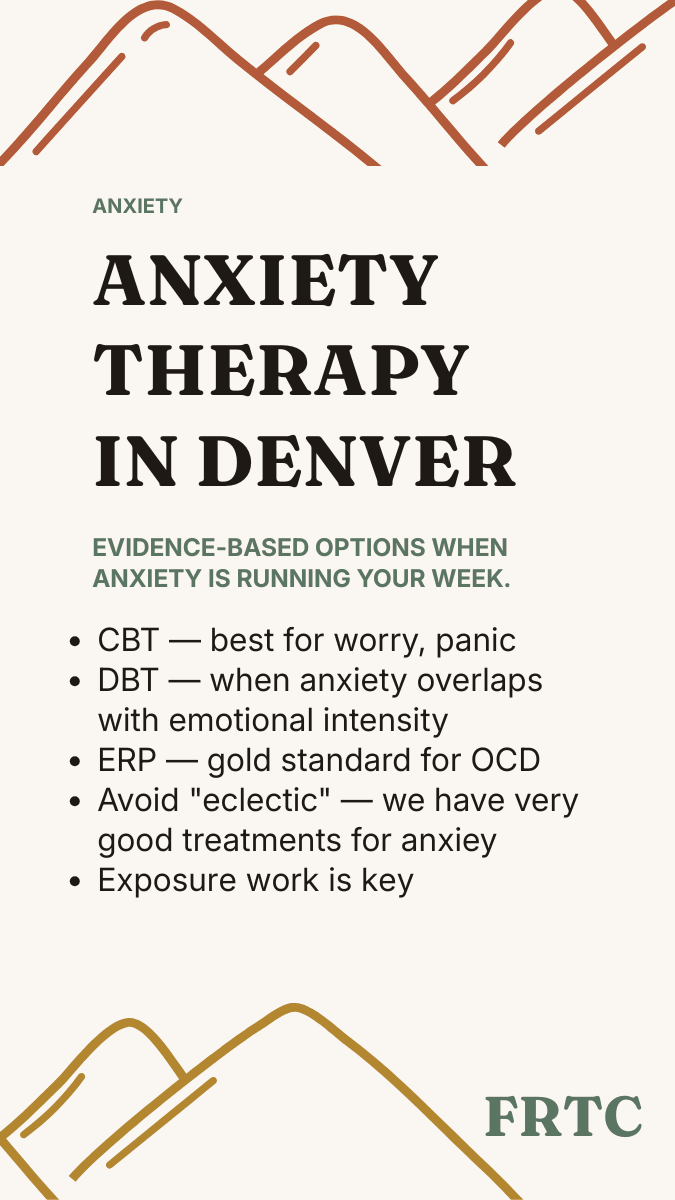
Choose CBT if your anxiety is relatively focused (one primary anxiety disorder), you want a structured and time-limited treatment, and you’re looking for practical tools to manage worry and avoidance.
Choose DBT if your anxiety co-occurs with emotional dysregulation, depression, relationship problems, or self-destructive behaviors. DBT’s comprehensive approach addresses anxiety within the broader context of emotional health.
Choose exposure therapy if you’re dealing with OCD, specific phobias, or social anxiety where avoidance is the primary maintaining factor.
Consider a combination if your presentation is complex. Many effective treatment plans draw from multiple modalities, tailored to what’s driving your anxiety.
What to Look for in a Denver Anxiety Therapist
Beyond the treatment approach, here’s what to consider when choosing a therapist:
Training and specialization. Look for therapists who specifically treat anxiety, not just therapists who list anxiety among twenty other specialties. Ask about their training in CBT, DBT, or exposure therapy.
Evidence-based practice. “Eclectic” or “integrative” approaches can be code for “I do a little of everything but don’t specialize in anything.” Effective anxiety treatment is structured and evidence-based.
Willingness to do exposure. Many therapists who say they treat anxiety avoid exposure work because it’s uncomfortable — for the therapist. If your therapist has never suggested facing your fears in a structured way, that’s worth questioning.
Good fit. The therapeutic relationship matters. You should feel heard, respected, and gently challenged. A therapist who only validates without pushing you forward won’t help you overcome anxiety — and one who pushes without building trust will feel unsafe.
The Denver Context
Denver’s therapy landscape is large and growing, which is both an advantage and a challenge. More options means more access, but it also means more variability in quality.
A few things specific to Denver: altitude can intensify physical anxiety symptoms (racing heart, shortness of breath) that get misinterpreted as panic. The active outdoor culture can create pressure to “just go outside and exercise” rather than seek treatment. And the high cost of living can make finding affordable, high-quality therapy feel like its own source of stress.
At Front Range Treatment Center, we specialize in evidence-based treatment for anxiety through both CBT and DBT approaches. Our therapists are trained in exposure techniques and deliver structured, measurable treatment — not open-ended talk therapy.
When Anxiety Co-Occurs with Other Conditions
Anxiety rarely exists in isolation. It frequently co-occurs with depression, trauma, BPD, substance use, and eating disorders. When anxiety is part of a larger clinical picture, treatment needs to account for the full picture rather than targeting anxiety alone.
This is one reason that a comprehensive assessment matters. If your therapist treats your generalized anxiety but misses the underlying PTSD that is driving the hypervigilance, or addresses your panic attacks but overlooks the emotional dysregulation that makes them worse, progress will be limited. A thorough intake assessment should explore not just your anxiety symptoms but your emotional history, relationship patterns, trauma history, and any other conditions that may be contributing.
At FRTC, our intake process is designed to identify these co-occurring patterns so that treatment can be appropriately matched. For some clients, focused CBT for anxiety is sufficient. For others, a comprehensive DBT program that addresses anxiety within the broader context of emotional regulation and interpersonal functioning is a better fit. And for clients with anxiety and OCD, structured exposure therapy with an ERP-trained therapist is the most effective path.
The Anxiety Treatment Timeline
One of the most common questions about anxiety therapy is how long it takes. The honest answer varies, but some general patterns hold. For specific phobias, exposure-based treatment can produce significant improvement in as few as five to eight sessions. For generalized anxiety and social anxiety, CBT typically runs twelve to twenty sessions, with most clients experiencing meaningful relief within the first two to three months. For anxiety that co-occurs with other conditions, treatment may take longer — particularly if a stabilization phase is needed before the anxiety-specific work begins.
What is consistent across approaches is that early engagement predicts better outcomes. Clients who actively practice skills between sessions, complete homework assignments, and engage with exposure exercises tend to improve faster than those who treat therapy as a passive, once-a-week experience. Anxiety treatment works best when it extends beyond the therapy room into daily life.
It is also important to set realistic expectations about what “better” looks like. The goal of anxiety treatment is not to eliminate anxiety entirely — that would be neither possible nor desirable, since some anxiety is functional and protective. The goal is to bring anxiety down to a level where it no longer controls your decisions, limits your relationships, or diminishes your quality of life. Most clients find that as their anxiety becomes manageable, their world expands: they pursue opportunities they had been avoiding, engage more fully in relationships, and experience a sense of freedom that anxiety had been quietly eroding.
Taking the First Step
If anxiety is interfering with your daily life, the most important thing isn’t which therapy you choose — it’s that you start. Research consistently shows that the biggest predictor of improvement is simply beginning evidence-based treatment.
Most anxiety therapists in Denver offer initial consultations. Use that conversation to ask about their approach, training, and how they’d structure treatment for your specific concerns. A good therapist will be transparent about their methods and clear about what to expect.
Related Reading
Ready to do something about the anxiety?
Our CBT track uses exposure-based work — the approach with the best evidence for anxiety — with clinicians who do this every day.
Send a message →We usually reply within one business day. In a crisis, call or text 988.