ADHD and DBT: Why Skills Training Helps
ADHD and emotion dysregulation often go hand in hand. Learn how DBT skills training helps manage ADHD symptoms from Denver DBT therapists.
In this article
When most people think of ADHD, they think of attention — the difficulty focusing, the distractibility, the lost keys and forgotten appointments. But if you live with ADHD, you know it goes much deeper than that. ADHD affects how you experience and manage emotions, and that emotional dimension is often the part that causes the most pain in relationships, at work, and in your sense of self.
This is where Dialectical Behavior Therapy (DBT) comes in. While DBT was not originally designed for ADHD, the overlap between ADHD-related challenges and the skills DBT teaches is remarkably close. For many people, DBT skills training becomes one of the most practical tools in their ADHD toolkit.
The Emotional Side of ADHD
ADHD is fundamentally a disorder of self-regulation — not just of attention, but of emotion, motivation, and impulse. Research consistently shows that emotion dysregulation is a core feature of ADHD, not a side effect. People with ADHD often experience emotions that are more intense, more sudden, and harder to recover from than their neurotypical peers.
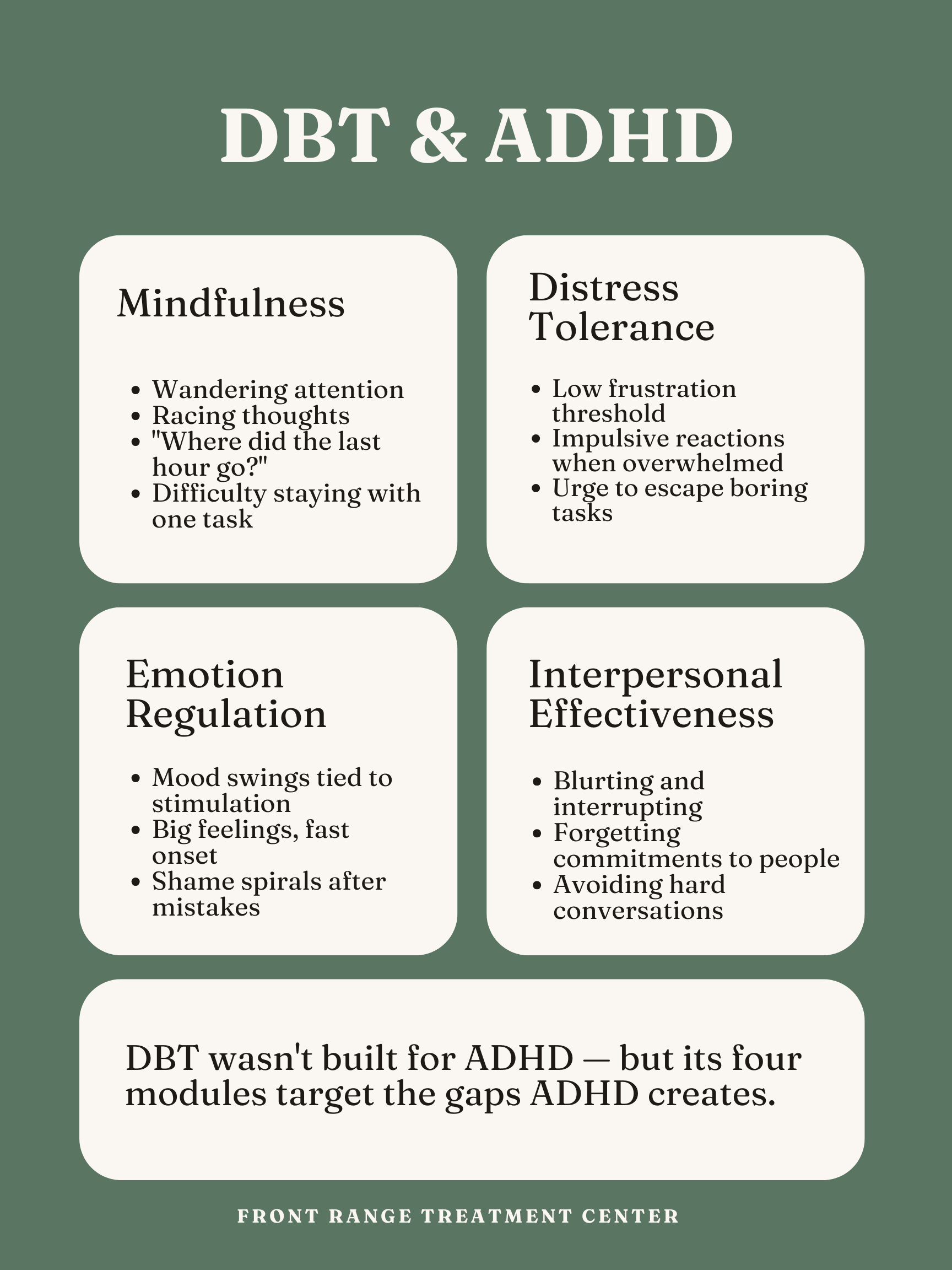
You may recognize some of these patterns: reacting with outsized frustration to minor inconveniences, feeling deeply wounded by perceived criticism or rejection, cycling rapidly between excitement and despair, or struggling to tolerate boredom or waiting. These are not character flaws. They are features of a nervous system that processes emotional information differently.
The problem is that most ADHD treatments focus on attention and executive function — medication, organizational strategies, time management techniques. These are valuable, but they do not directly address the emotional reactivity, impulsivity in relationships, or distress intolerance that can derail your day just as effectively as forgetting an appointment.
Why DBT Is a Good Fit
DBT was built for exactly the kind of problems that ADHD creates emotionally. It teaches concrete, practical skills for managing intense emotions, tolerating distress, staying present, and communicating effectively — all areas where ADHD makes life harder.
Several features of DBT make it particularly well-suited for people with ADHD.
It is skills-based and structured. DBT skills classes follow a clear curriculum with specific skills to learn each week. For a brain that struggles with open-ended or abstract therapy, this structure is grounding. You are not asked to sit and reflect for an hour. You are given a tool, shown how to use it, and asked to practice it before the next session.
It is concrete and immediately applicable. DBT skills are designed to be used in real life, in real time. You learn a skill on Tuesday and use it during a conflict on Thursday. This practical orientation fits the ADHD need for relevance and immediate applicability — you can see how the skill connects to your actual life right away.
It addresses the right problems. While traditional talk therapy might explore why you feel the way you do, DBT focuses on what to do when you feel that way. For someone with ADHD who already knows they overreact but cannot seem to stop, the “what to do” is exactly what has been missing.
DBT Skills That Help With ADHD
Each of the four DBT skill modules addresses a specific area of difficulty that overlaps with ADHD challenges.
Mindfulness
Mindfulness skills teach you to anchor your attention in the present moment — to observe what is happening without immediately reacting to it. For ADHD, this is transformative. The practice of noticing a thought or emotion without acting on it creates a gap between stimulus and response that ADHD tends to collapse. Over time, mindfulness strengthens your ability to choose where your attention goes rather than being dragged by whatever is loudest.
Distress Tolerance
Distress tolerance skills help you survive intense emotional moments without making them worse. ADHD often creates a low threshold for frustration — a computer that freezes, a plan that changes, a conversation that does not go as expected can feel unbearable. Distress tolerance teaches you to ride out that wave of frustration without acting impulsively, whether that means snapping at someone, quitting a task, or doing something you will regret.
Emotion Regulation
Emotion regulation skills help you understand your emotions, reduce your vulnerability to emotional extremes, and change emotions that are not serving you. For ADHD, this means learning to recognize the early signs of an emotional escalation and intervene before you reach the point of no return. Skills like reducing vulnerability through sleep, exercise, and nutrition are particularly important for ADHD, where physical state directly impacts emotional stability.
Interpersonal Effectiveness
Interpersonal effectiveness skills teach you how to ask for what you need, say no, and handle conflict without damaging your relationships or your self-respect. ADHD can make relationships especially challenging — impulsive communication, difficulty listening, emotional reactivity during conflict. Skills like DEAR MAN give you a step-by-step framework for navigating these moments with intention rather than impulse.
DBT as a Complement, Not a Replacement
It is important to note that DBT does not replace other ADHD treatments. Medication, coaching, and accommodations all play important roles for many people with ADHD. What DBT provides is the emotional skills layer — the piece that medication does not fully address and that most ADHD interventions skip over entirely.
Many of our clients find that DBT skills make their other ADHD strategies work better. When you can regulate your emotions and tolerate frustration, the organizational systems and time management techniques you have been taught actually stick. The skills become the foundation that everything else is built on.
Rejection Sensitive Dysphoria and DBT
One of the most painful aspects of ADHD that rarely gets discussed in clinical settings is rejection sensitive dysphoria (RSD) — the experience of overwhelming emotional pain in response to perceived rejection, criticism, or failure. RSD is not a formal diagnosis, but the experience is well-documented among people with ADHD and can be profoundly disabling. A perceived slight from a friend, a critical comment from a supervisor, or even imagining that someone is disappointed in you can trigger emotional pain so intense that it derails your entire day.
DBT offers several tools that directly address RSD. Check the facts helps you evaluate whether the perceived rejection is real or whether your ADHD-influenced emotional system is amplifying an ambiguous signal. Opposite action asks you to approach the person or situation you want to flee from, breaking the avoidance pattern that RSD creates. Radical acceptance helps you acknowledge the pain of rejection without adding layers of shame about having the reaction in the first place.
For many people with ADHD, naming the RSD pattern and having specific tools to manage it is transformative. It does not eliminate the sensitivity, but it prevents the sensitivity from controlling your behavior and destroying your relationships.
ADHD in Relationships
The emotional dimension of ADHD creates specific relational challenges that are often misunderstood by partners and family members. Impulsive communication — saying things without thinking, interrupting, or blurting out reactions — can feel aggressive or dismissive to the other person even when no harm was intended. Difficulty sustaining attention during conversations can make partners feel unimportant. Emotional reactivity during disagreements can escalate minor conflicts into major ruptures.
DBT’s interpersonal effectiveness skills are particularly valuable here. DEAR MAN provides a structured framework for having difficult conversations — one that compensates for the ADHD tendency to lose the thread or get derailed by emotion. The GIVE skill helps you maintain warmth and connection during conflict even when your nervous system is activated. The FAST skill helps you advocate for yourself without the impulsive self-sacrifice that many people with ADHD resort to when they feel guilty about their emotional reactivity.
Partners of people with ADHD often benefit from learning these skills as well. Understanding that your partner’s emotional intensity is neurological rather than volitional changes the frame of the interaction — from blame to problem-solving, from frustration to compassion. Our Friends and Family DBT program provides this shared vocabulary.
Getting Started
If you have ADHD and find that the emotional side — the reactivity, the impulsivity, the difficulty tolerating frustration — is causing as much trouble as the attention side, comprehensive DBT may be a strong fit.
If you have not actually been evaluated — or you were told as a child and it has never been formally confirmed — that is a separate question, and skills training is not the way to answer it. ADHD testing in Denver covers what a full evaluation involves, what it costs, and who it is for.
In our comprehensive DBT program, you learn and practice these skills in weekly skills classes alongside individual therapy. If you are interested in learning more, contact us to find out about our programs for adults and teens in the Denver area.
Related Reading
Not sure where to start?
Tell us what’s going on and we’ll point you to the right program — ours or someone else’s.
Send a message →We usually reply within one business day. In a crisis, call or text 988.