What Parents Do in Teen DBT — and Why It Matters
Your role when your teen starts DBT: the multi-family skills group, what you practice at home, and why parent involvement changes outcomes.
In this article
Your teenager is struggling. Maybe it’s explosive anger that seems to come out of nowhere. Maybe they’re withdrawing from friends, cutting, or talking about not wanting to be alive. Maybe their therapist suggested Dialectical Behavior Therapy (DBT) and you’re not sure what that means or whether it’s the right fit.
This guide is for you. Here’s what parents need to know about DBT for teens — how it works, what makes it different, and what your role looks like.
What Is DBT, and Why Is It Used for Teens?
DBT was originally developed by Dr. Marsha Linehan to treat adults with severe emotional dysregulation, particularly borderline personality disorder. Over the past two decades, researchers have adapted it specifically for adolescents — a version often called DBT-A (Dialectical Behavior Therapy for Adolescents).
The core insight behind DBT is that some people experience emotions more intensely, react more quickly, and take longer to return to baseline than others. This isn’t a character flaw — it’s often rooted in biology. When you combine that emotional sensitivity with an environment that hasn’t fully learned how to respond to it (what DBT calls the biosocial theory), the result is a teen who feels overwhelmed by feelings they don’t have the tools to manage.
DBT gives them those tools.
How Teen DBT Differs from Adult DBT
Adult DBT programs typically run for a year or more. Teen DBT is usually shorter — around 16 to 24 weeks — and makes several key adaptations:
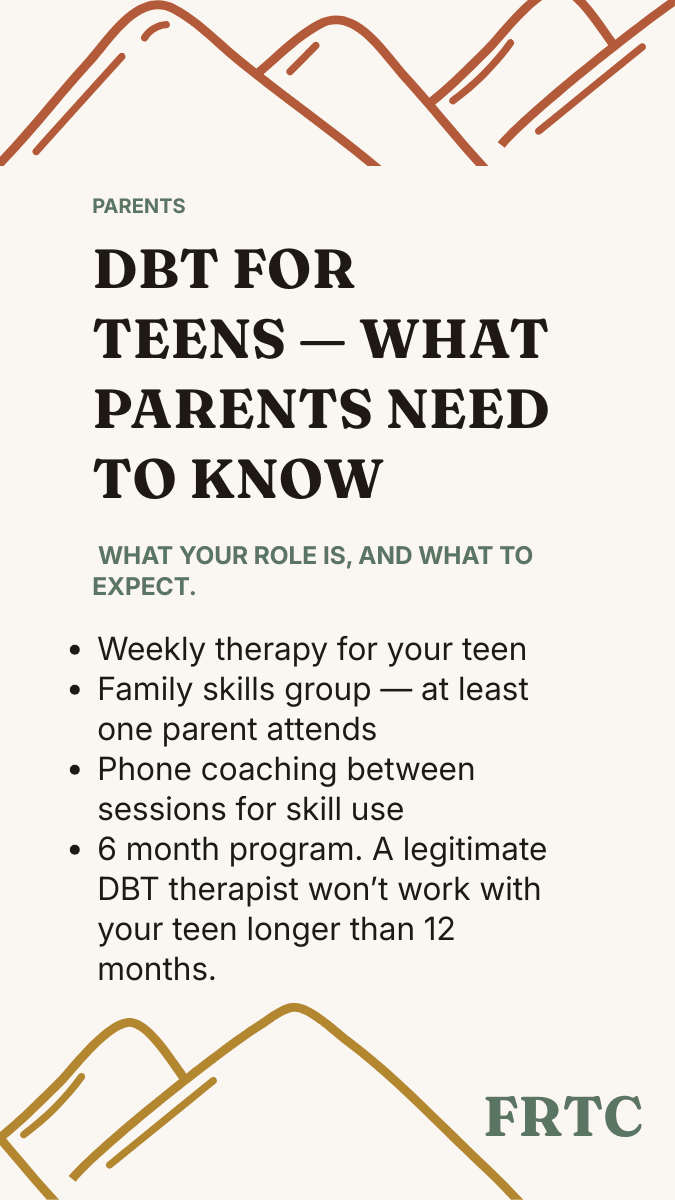
Family involvement is built in. In adult DBT, skills groups are made up of individual clients. In teen DBT, at least one parent or caregiver attends the multi-family skills group alongside the teen. This isn’t optional — it’s a core part of the model. When parents learn the same skills their teen is learning, the whole household speaks the same language.
A fifth skills module is added. Adult DBT teaches four modules: mindfulness, distress tolerance, emotion regulation, and interpersonal effectiveness. Teen DBT adds a fifth: Walking the Middle Path. This module addresses the dialectical dilemmas that are specific to adolescence — the tension between wanting independence and needing parental support, between making your own decisions and accepting guidance.
The language is adapted. Concepts and materials are presented in ways that resonate with adolescents. Acronyms, worksheets, and examples are age-appropriate. Diary cards are simplified. The tone is direct and collaborative rather than clinical.
What a Typical Week Looks Like
A comprehensive teen DBT program has the same structure as the adult version — just adapted for families:
Individual therapy (weekly). Your teen meets one-on-one with their DBT therapist. Sessions focus on applying skills to whatever is most urgent that week — a conflict at school, a self-harm urge, a relationship rupture. The therapist uses the diary card to track patterns and progress.
Multi-family skills group (weekly). Teens and parents attend together. Each week covers a specific skill from one of the four modules (distress tolerance, emotion regulation, interpersonal effectiveness, and walking the middle path), with mindfulness woven through all of them. You’ll practice the skill in the group, discuss how to use it at home, and often do exercises together. This shared experience is one of the most powerful parts of teen DBT.
Phone coaching (as needed). Between sessions, your teen (and you) can reach out to the therapist for brief coaching in real time. This isn’t therapy — it’s a quick skill application. “I’m about to lose it with my mom — what skill should I use right now?” The 4-miss rule applies to keep everyone accountable.
Consultation team. Behind the scenes, your teen’s therapist meets weekly with other DBT therapists to discuss cases, stay effective, and prevent burnout. You won’t see this directly, but it’s a quality safeguard. Learn more about how consultation teams work.
What Parents Actually Do in DBT
This is where many parents get nervous. Being involved in your teen’s therapy doesn’t mean being in the hot seat. Here’s what it actually looks like:
You learn the skills. The same mindfulness, distress tolerance, and emotion regulation skills your teen is learning, you’re learning too. This means when your teen says “I need to TIPP” or “I’m trying to use opposite action,” you know exactly what they mean — and you can reinforce it.
You practice validation. Validation is one of the most important things parents learn in DBT. It doesn’t mean agreeing with your teen’s behavior. It means communicating that their emotions make sense given their experience. For a teen who has felt chronically misunderstood, this is transformative.
You work on your own patterns. DBT asks parents to examine how they respond to their teen’s distress. Do you dismiss? Escalate? Over-accommodate? Walking the Middle Path helps you find the balance between too rigid and too permissive, between pushing for change and accepting where your teen is right now.
You don’t need to be perfect. DBT is realistic about families. You’ll make mistakes. You’ll lose your temper. The framework gives you tools to repair, reconnect, and try again — which is exactly what your teen is learning to do.
When Is DBT the Right Choice for a Teen?
DBT for teens is typically recommended when a teenager is experiencing:
- Intense emotional reactions that seem disproportionate to the situation
- Self-harm (cutting, burning, hitting)
- Suicidal thoughts or behavior
- Chronic interpersonal conflict with family or peers
- Impulsive behavior (substance use, risky sexual behavior, binge eating)
- Difficulty functioning at school due to emotional overwhelm
- A diagnosis or suspected diagnosis of BPD, depression, or anxiety that hasn’t responded well to standard therapy
If your teen’s emotions are consistently out of proportion to the situation and their current coping strategies are making things worse, DBT is worth exploring.
What Progress Looks Like
Parents often ask how they will know DBT is working. The answer is usually not dramatic overnight change. Instead, you’ll notice incremental shifts: your teen uses a skill once during a conflict instead of escalating. They come to you after a hard day instead of retreating to their room. The time it takes them to recover from an emotional episode gets shorter. Arguments still happen, but they don’t last as long or get as intense.
It’s also common for things to feel harder before they feel easier. As teens learn to identify and name their emotions, there can be a period where they seem more emotionally expressive, not less. This is actually a sign that the therapy is working — they’re becoming more aware of what they’re feeling rather than acting it out unconsciously. Your own skills, learned in the multi-family group, help you navigate this transition rather than interpreting it as a setback.
For parents who want additional context on the developmental factors at play, our post on emotion dysregulation in adolescence covers why the teenage brain is uniquely vulnerable to emotional intensity — and why the skills learned in DBT are particularly well-timed for this developmental stage.
What DBT Is Not
A few common misconceptions:
DBT is not a punishment. Some teens hear “you need a special program” and assume they’re broken or in trouble. DBT is a skills-based education program as much as it is therapy. Framing it that way — “we’re going to learn tools as a family” — can help.
DBT doesn’t replace medication. If your teen is on medication for depression, anxiety, or ADHD, DBT works alongside it. Many teens benefit from both.
DBT isn’t forever. A typical teen program lasts about 4 to 6 months. The goal is for your teen to internalize the skills so they don’t need the program anymore — though some families choose to continue or return for refreshers. The skills your teen learns in DBT are life skills — they’ll use them in college, in future relationships, and in navigating the challenges of adulthood.
Teen DBT at Front Range Treatment Center
At FRTC, our teen DBT program follows the comprehensive model: individual therapy, multi-family skills group, phone coaching, and a therapist consultation team. We work with teens ages 13–17 and their families throughout the Denver metro area. We also offer a child DBT program for younger kids and a dedicated Friends & Family program for parents who want additional support.
If you’re a parent trying to figure out the right next step for your teenager, reach out or call us at (720) 390-6932. We’ll talk through what’s going on and whether DBT is the right fit. And if you’re not sure your teen needs the full program, our teen therapy in Denver page covers all the ways we work with adolescents — including weekly individual therapy.
Related Reading
Worried about your teen?
Our teen DBT program treats the whole family, not just the adolescent — parents are built into the work rather than left in the waiting room.
Send a message →We usually reply within one business day. In a crisis, call or text 988.